Culinary Hamburg
10 Restaurants, Bars, and Food Spots You Shouldn't Miss
24 October 2026 · Alexandra Gorsche
A city that is perhaps best understood by eating your way through it. Because between the Elbe, Speicherstadt, HafenCity, and St. Pauli lie distinct culinary worlds: a Fischbrötchen right at the Landungsbrücken, oysters between fish counters, ceviche with harbor views, caviar in desserts, and some of Germany’s most ambitious fine-dining concepts. After a few very intense days, one thing stands out above all for me: Hamburg can be gritty and highly precise, down-to-earth and luxurious, Hanseatic and cosmopolitan all at once.
1. Brücke 10: A Fischbrötchen Is an Absolute Must
Eating a Fischbrötchen in Hamburg? You have to. There's almost no other way. And my top tip remains Brücke 10 at the Landungsbrücken. Here, you sit right where Hamburg feels most like Hamburg: harbor, seagulls, ships, wind, and a bread roll in hand. For me, the absolute must is the Kräutermatjes. Brücke 10 itself calls it one of its classics. The matjes is deliberately served there without any unnecessary frills; it is precisely this "less is more" approach that makes it so appealing. And that is exactly what fascinates me about great food spots: not every culinary experience requires tweezers and fine porcelain. Sometimes, fish, bread, salty sea air, and the right spot are all you need.
2. FrischeParadies: Experiencing Hamburg's Produce Side
Anyone who wants to understand why Hamburg is culinarily so closely linked to fish and seafood should also head to where restaurateurs shop. At FrischeParadies Hamburg, the product itself becomes the experience. We started here with oysters, among other things, and suddenly a visit to a wholesale market turns into something like a mini culinary masterclass. Because before talking about preparation, good cooking always begins with one question: What actually makes a good product? Especially with fish and seafood, this is tremendously exciting: origin, catch, freshness, season, and quality are immediately visible here. You can enjoy a leisurely lunch, do some shopping, or simply savor a glass of wine. The culinary side is led by Ivan Pagel, who was even nominated in the Chef of the Year category at the Genuss-Creator Award. Making a reservation is definitely recommended, as seating is limited.
FrischeParadies Hamburg
© Alexandra Gorsche
Back row, from left: Koral Elci (Table Dot), Thomas Imbusch (100/200 Kitchen), Simon Sauter (haebel), Marcel Görke (Heimatjuwel), Malte Heinrich (haebel). Front row, from left: Julian Stowasser (Lakeside), Maurizio Oster (Zeik), Michael Otremba (Managing Director Hamburg Tourismus GmbH), Paul Decker (Koer)
© Mediaserver Hamburg
And What Must You Actually Eat in Hamburg?
If you only experience Hamburg through Michelin-starred restaurants, you're missing out on half the story. Among the dishes that I believe absolutely belong on any culinary Hamburg list are:
Labskaus: This delightfully quirky sailor's dish, which can taste far better than its reputation suggests. A Northern German classic made from cured beef, potatoes, and onions, traditionally often served with beetroot, a fried egg, pickles, and rollmops. Hearty, salty, slightly tangy, and much more refined than its appearance might initially suggest.
Scholle Övelgönne mit Büsumer Krabben: Pan-fried plaice meets tiny North Sea brown shrimp, usually accompanied by melted butter, lemon, and classic sides. A dish that brings the taste of the coast straight to your plate.
Hamburger Pannfisch: Various pieces of pan-fried fish served with potatoes and a rich mustard sauce. What once originated as humble leftover fare is now one of the most quintessential comfort foods in Hamburg cuisine.
And of course: Fischbrötchen.
On the sweet side, you can hardly pass up a Franzbrötchen: cinnamon, butter, caramelized edges, somewhere between a croissant, Danish pastry, and Hamburg identity. And if there’s still room: Rote Grütze. A dessert that sounds far less spectacular than it can taste, especially when acidity, sweetness, and vanilla are perfectly balanced.
These dishes tell a story that no tasting menu can tell: where the city comes from.
Labskaus
© Matthias Lipinski / Pixabay
Fischbrötchen
© Matthias Lipinski / Pixabay
Rote Grütze
© Mike Ljung / Pixabay
Scholle Övelgönne mit Büsumer Krabben
© Alexandra Gorsche
3. The Table: Hamburg Around the World
What does the Gateway to the World actually taste like? Kevin Fehling offers a pretty spectacular answer at The Table. The three-Michelin-starred restaurant in HafenCity takes its guests on a culinary journey that connects diverse countries and flavor cultures. Fittingly, our menu was titled "The Gateway to the World". And this journey began with small bites such as a pie tee shell with unagi, a Japanese taco with foie gras, and beef tartare with beetroot and sardine. Later came dishes including lobster, langoustine, and amaebi with the flavors of Southern France, a turbot crêpinette, Swiss chard, young peas, and shrimp beurre blanc, as well as a tart with pea cream, lardo, and caviar. Quail and Challans duck also played their parts before shifting into sweet territory with a citrus cheesecake and ginger beer sorbet.
What remains particularly memorable: Fehling doesn't cook "internationally" just because internationality sounds chic. Rather, his cuisine works just like Hamburg itself: it absorbs influences from all over the world and transforms them into something entirely its own. And as you eat, you sit at that famous curved table, looking directly into the kitchen. Here, communication is part of the concept.
Interior The Table Kevin Fehling
© Sven Schomburg Fotografie
Kevin Fehling
© Jürgen Müller
The Table Kevin Fehling
© René Riis
Gurkensalat
© René Riis
4. 100/200 kitchen and GLORIE: Two Restaurants. One Room. One Philosophy.
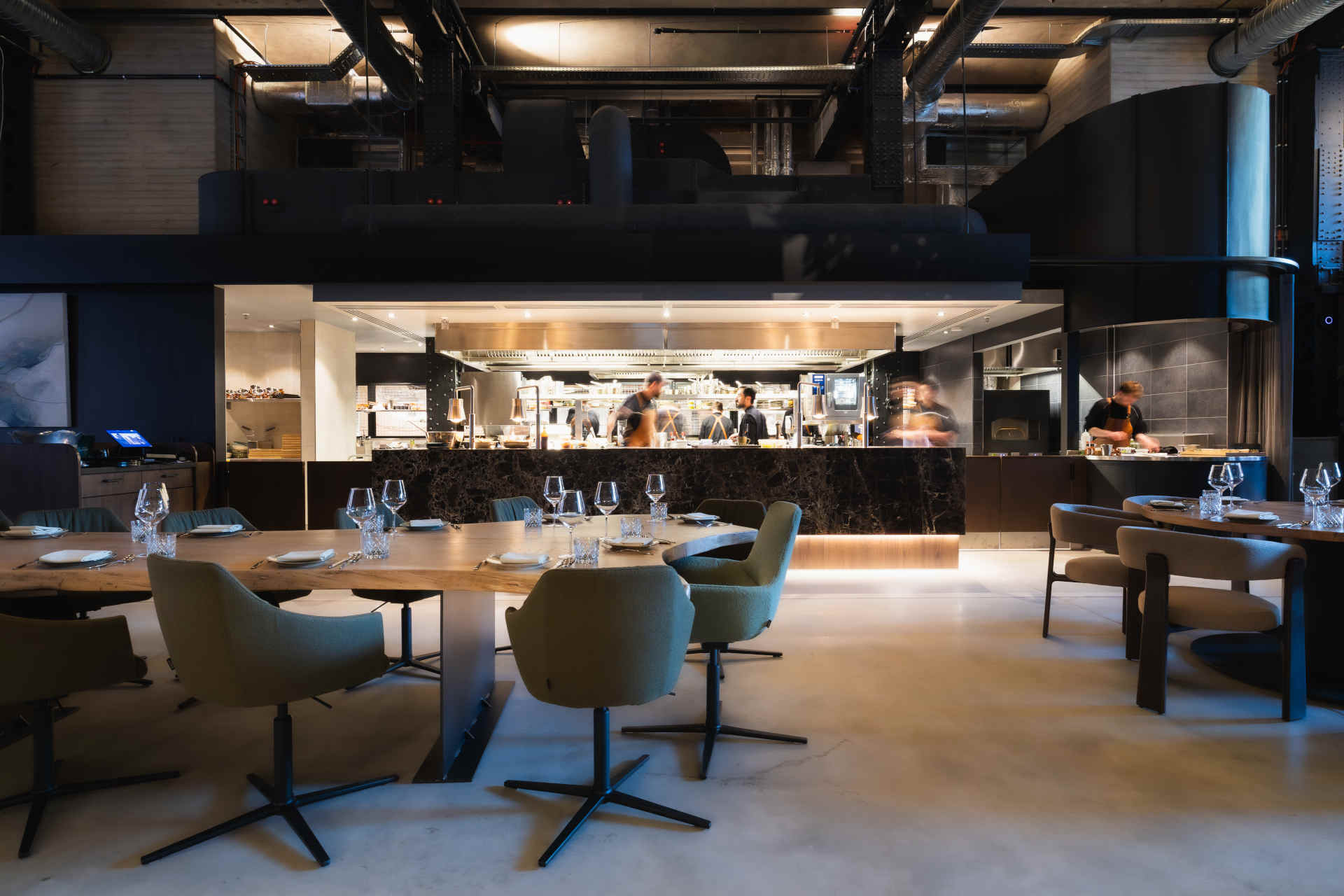
This venue surprised me architecturally as well. Because there was one thing I hadn't fully realized before my visit: 100/200 kitchen and GLORIE are actually located in the very same room and yet function as two separate restaurants. Downstairs: 100/200 kitchen. Two Michelin stars, carte blanche, and the deliberate decision to put yourself in the hands of Thomas Imbusch, Sophie Lehmann, and their team. Upstairs on the gallery: GLORIE. Here, guests decide for themselves and order à la carte. The same kitchen, the same ingredients, the same philosophy, but an entirely different experience. Lehmann and Imbusch themselves describe precisely this distinction as the core of their two concepts.
And then there's the kitchen. Not a show kitchen concealing a real prep kitchen somewhere in the back. The Molteni stove sits visibly on a platform in the room and is genuinely the center of the action. Heat, craft, communication, music, and service all unfold right before the guests' eyes. From GLORIE, you look down as if from a theater balcony onto a stage: watching the chefs, the guests at 100/200, the plates, the workflow. That is gastronomically thrilling, but it is at least as exciting logistically and architecturally. Interior design becomes an integral part of the restaurant concept here. Raw, slightly industrial, uncompromising, and emotional all at once. My conversation with Thomas Imbusch only reinforced this impression: this is not about staging fine dining to look as polished as possible. It's about making gastronomy visible.
© Christian Brandes
© Alexandra Gorsche
© Christian Brandes
© Christian Brandes
5. XO Seafood Bar: Exceptional Seafood and Caviar for Dessert
Just a few minutes later, Hamburg can taste completely different again. Lutz Lonchant personally showed us around XO Seafood Bar and the Michelin-starred restaurant hæbel, located right across from each other. XO is the more casual side of this culinary world: fish and seafood, products from sustainable wild catches or farming, and ingredients sourced from the Hamburg region take center stage. Well-known classics include oysters, prawns, and the "Pasta Krabbe."
Our menu, however, was even more exciting. A tartlet with Faroe Islands langoustine tartare, salted lemon, and caviar opened the evening. Next up: white tiger prawn with chili sauce made from unripened chilies and aged buttermilk. Then sea bass with tomato salad and smoked almonds. And finally, a dessert that got me thinking about a trend I'm noticing more and more frequently these days: ice cream, whipped cream, salted nuts, chocolate sauce, and caviar. I've been encountering caviar in desserts remarkably often lately. From Amsterdam to Hamburg. And in truth, the combination makes complete sense: salt, fat, sweetness, and umami create precisely that tension that is pulling desserts increasingly away from pure sweetness. Perhaps caviar is currently in the process of finally transitioning from a luxury topping to a culinary seasoning.
6. hæbel: What Does an Ecosystem Actually Taste Like?
Directly across the street comes a shift in perspective. hæbel sees its cuisine as a showcase for the Northern German ecosystem. The concept consists of two tasting menus: "Flora" is entirely vegetarian; "Fauna" builds upon it, adding components from the waters and forests of the North. Sustainably hunted game, line-caught fish, vegetables, herbs, and mushrooms are explicitly placed in a resource-conscious context. And that is precisely what I find interesting: sustainability is not treated as an added marketing label here, but directly shapes what gets cooked in the first place. The question is: What is available to us right now, and how much of it do we truly need?
7. Chefs Warehouse Hamburg: Where Restaurant, Art, and Event Venue Merge
And then, it's time to loosen the gastronomic tie once again. Since March 2026, the South African Chefs Warehouse concept has also had an address in Hamburg, and in quite spectacular fashion: inside the historic, heritage-listed Maschinenzentralstation in the Speicherstadt, just steps away from the Elbphilharmonie, Miniatur Wunderland, and HafenCity. The story behind it is fascinating: Liam Tomlin opened the first Chefs Warehouse in 2014 on Bree Street in Cape Town. The concept became known for, among other things, its "Tapas for Two" and a cuisine that combines high product quality and culinary craft with a deliberately relaxed dining style. Hamburg is now part of a group of nine establishments and brings this concept effortlessly to the Hanseatic city.
We were given a tour of the building, and only then do you realize that what has been created here is more than just a restaurant. The architecture is extraordinary, there are separate rooms for seminars and events, and art plays a surprisingly major role. The works on the walls are not mere decoration: the paintings are for sale. A restaurant visit thus partly merges with a gallery, design space, and event location. Culinarily, the whole thing works in a delightfully casual way. We started with oysters and then moved on to sharing—which is precisely what the concept is ideally suited for. The menu ranges from Irish Oyster with Vietnamese dressing and nori to Hamachi Crudo with ponzu, grapefruit, and jalapeño, all the way to Seafood Curry, Cacio e Pepe, or Beef & Bone Marrow. Vegetarian options include dishes like Tandoori Cauliflower or grilled broccoli with buffalo mozzarella, pistachios, and Dijon dressing.
That is also why Chefs Warehouse is so compelling for the hospitality industry: restaurant, bar, art, design, and event spaces are not conceived separately, but as diverse uses of a single venue. Anyone in Hamburg looking for an extraordinary location for dinner, business events, or private gatherings should definitely keep this address in mind.
© Chefs Warehouse Hamburg
© Chefs Warehouse Hamburg
© Chefs Warehouse Hamburg
© Chefs Warehouse Hamburg
8. Bistro Crudo: A Touch of Wanderlust with Views of Hamburg Harbor
And then Hamburg gets another notch more casual and international. Bistro Crudo by Salt & Silver is precisely the kind of place where you want to order a table full of plates. Tacos, ceviches, bar food, wine, and drinks. The kitchen deliberately sees itself as an uncomplicated culinary trip around the world. In addition, there are regular pop-ups featuring guest chefs from different countries. What works wonderfully here is the contrast: you look out over Hamburg Harbor while mentally tasting your way toward Latin America. Perhaps that is precisely modern Hamburg: home in view, wanderlust on your plate.
© Thomas Kosikowski
© Thomas Kosikowski
© Thomas Kosikowski
© Thomas Kosikowski
9. Pâtisserie Johanna: When Pastries Tell a Story
Pâtisserie Johanna was, for me, one of those places that is far more than just a pretty coffee stop. The location alone is special: housed in a former cocoa warehouse in the Speicherstadt, a glass-fronted patisserie spanning roughly 700 square meters allows you to watch the pastry chefs at work. Chef Pâtissier Marcel Reinhardt turns tartlets, chocolates, viennoiserie, and ice cream into mini design objects. He personally served me another one of those thrilling sweet-and-savory combinations trending right now: croissant with vanilla ice cream, crumbles, and caviar, yet another example of how naturally caviar has made its way into dessert.
But behind the name Johanna lies a deeply personal story: the patisserie was founded in honor of Johanna Orth, whose dream had been to open her own patisserie and who lost her life in the 2021 Ahr Valley flood disaster. Suddenly, beauty gains a second dimension. The result is by no means a somber place—quite the opposite. It is a place that shows how culinary enjoyment can also be an act of remembrance and carrying a legacy forward. And that alone is reason enough to step inside.
© Christian Brandes
© Christian Brandes
10. The Rabbithole: Gorgonzola in a Cocktail, Please
When a bar names a drink "Say Cheese" and combines rum, sherry, walnut, pear, and Gorgonzola in it, you have a pretty good idea of what you're in for. The Rabbithole by Constanze Lay and Florian Sonneborn was awarded "Bar of the Year" at the Genuss-Michel in 2025. And in fact, this place is not about loud gimmicks, but about drinks that use surprising ingredients intelligently.
Gorgonzola in a cocktail? It works.
Garlic in the shaker? Can definitely happen.
At the same time, the team has mastered the classics and is increasingly working on sophisticated non-alcoholic drinks. This is exactly the kind of bar I love: a little crazy, but never just for the sake of being crazy.
© The Rabbithole Bar
© The Rabbithole Bar
Hamburg's Culinary Scene Thrives on Contrasts
A Kräutermatjes along the Elbe and three Michelin stars are sometimes only a few transit stops apart in Hamburg. Perhaps that is why the most important tip for this city is: don't just book fine dining. And don't just eat Fischbrötchen.
Hamburg becomes truly exciting right where both exist side by side. On top of that, culinary events regularly bring this scene together. One example is "Hamburgs Sterne by OPEN MOUTH", where in 2026 eight top chefs cooked together at TABLE DOT, deliberately translating fine dining into a more casual format. That is perhaps the best summary of this city: Hamburg can do Michelin stars. But Hamburg doesn't have to be stiff about it.