Thomas Imbusch: “A dish can never be perfect”
Thomas Imbusch, head chef and host of the two-star restaurant 100/200 Kitchen and the one-star restaurant GLORIE in Hamburg, talks about perfection, entrepreneurship and an industry that, for him, can never be just a job.
23 October 2026 · Alexandra Gorsche
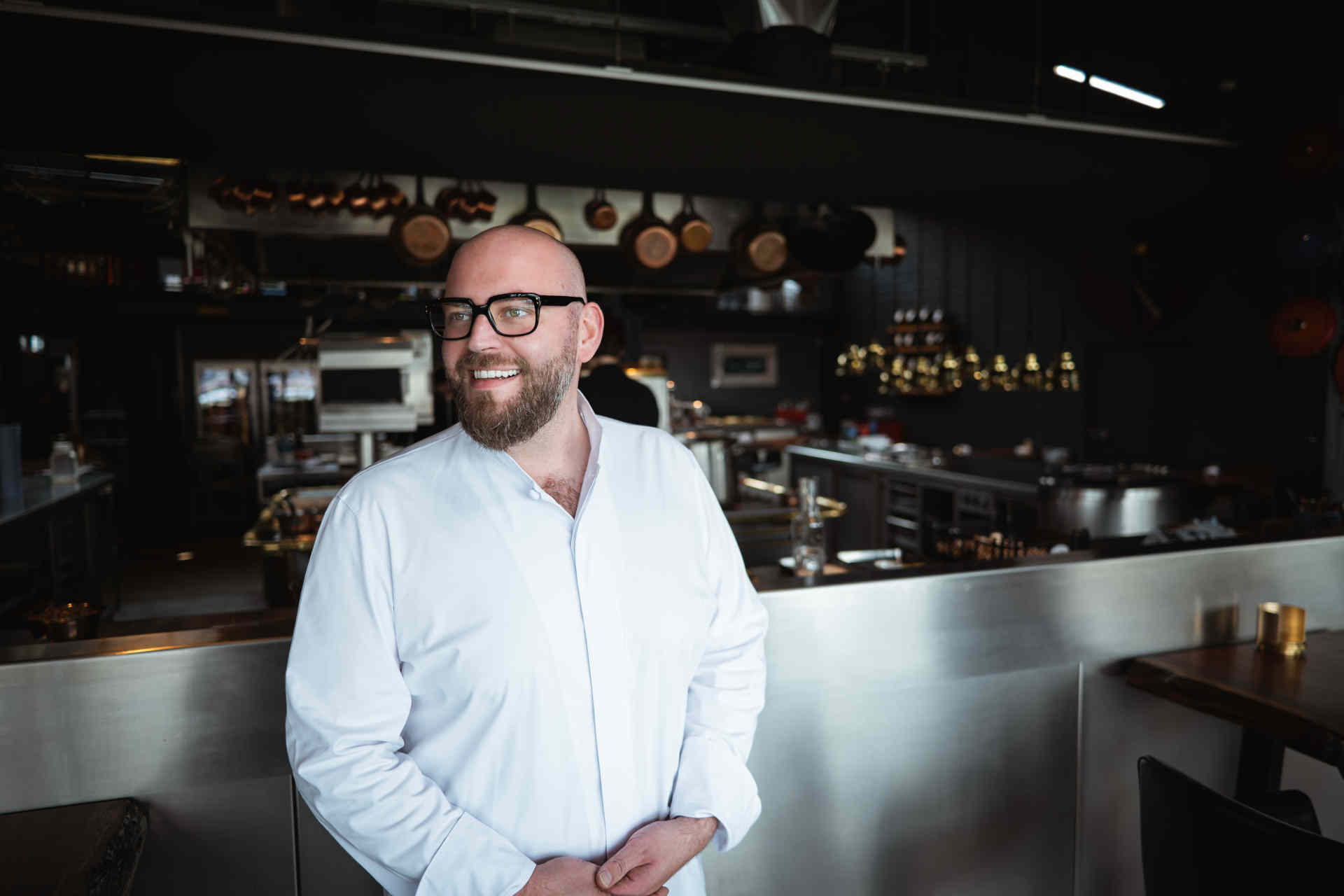
Anyone who asks Thomas Imbusch when a dish is perfect for him will receive a remarkably short answer.
“Never.”
Never?
“No.”
That could be the modesty of a two-star chef. But it isn’t. Rather, there is a principle behind it that reveals a great deal about Imbusch’s understanding of gastronomy. Food is never the same from one day to the next. Bread reacts to temperature and humidity. Vegetables change. Levels of ripeness shift. What worked yesterday needs to be readjusted today. “A dish can never be perfect because the ingredients we work with are always different.” This forces one to remain alert. Or, as Imbusch puts it: “Those who are alert create more beautiful things.”
Luxury is being able to make a living from it
His definition of luxury, too, has little to do with caviar or champagne. Luxury, he says, is doing what you love and find personally fulfilling, whilst at the same time being financially successful enough to make a living from it. Together with Sophie Lehmann, Imbusch has built up a family business. The two are husband and wife, parents and business partners. Four children are just as much a part of this life as two restaurants, events, consultancy work and other projects. “We’ve never actually ‘gone to work’”, says Imbusch of their joint venture, almost automatically dispelling any romanticised notion: “It’s our life. That’s not romance. That’s the reality of our daily lives.”
Why a Michelin-starred chef thinks about mouthful sizes
The conversation becomes particularly interesting when Imbusch discusses details that rarely feature in the public perception of fine dining. Take ‘eatability’, for example. How big should a mouthful be? How does a texture behave in the mouth? How should a dish be portioned so that it is pleasant for different people to eat? For Imbusch, this is part of the ongoing process of refinement. His cheese toastie has been on the menu since 2018. Nevertheless, he does not regard it as a finished signature dish that will one day be reproduced unchanged. A dish can always be improved further, not to make it look more spectacular, but to make it more enjoyable to eat. That may sound trivial at first. In a top-class kitchen that has long defined itself by complexity, technique and visual perfection, it is not.
Go and eat at your own restaurant
This ties in with another piece of advice that really ought to feature in every hospitality handbook: “You should eat at your own restaurant very often.” Why? Because otherwise, hosts run the risk of viewing a restaurant solely from a business perspective. An idea might seem brilliant from the team’s point of view but be completely irrelevant to the guest. It’s only when you’re seated at a table that you realise just how long an evening actually feels. How comfortable the chair is. How the cutlery feels in your hand. What a plate sounds like. How the lighting, smells and sounds come across. And whether the dish the kitchen is particularly proud of holds the same significance for the guest at all.
“Those who are awake create more beautiful things.”
Restaurant 100/200 Kitchen in Hamburg
© Rene Flindt
Restaurant 100/200 Kitchen in Hamburg
© Rene Flindt
Restaurant 100/200 Kitchen in Hamburg
© Rene Flindt
A restaurant should restore
This leads to a broader idea. Imbusch wants people to leave his restaurant feeling satisfied and happy: with the sense of having enjoyed a break from the everyday. In saying this, he refers to the origin of the word ‘restaurant’ and the idea of restoration, of bringing something back to life. For him, this sense of renewal does not come about through food alone. Light is part of it. The movement of water. Smells. Sounds. Music. And sometimes even disharmony. Not every dish needs to be pleasing. It’s perfectly fine for it to be ‘edgy’, to unsettle, or to resist an immediate ‘Oh wow, that’s delicious’ reaction. What matters is the experience as a whole.
Why every course needs a playlist
That is why music at 100/200 is not merely background noise. A playlist is curated for every course. Lehmann draws on her classical musical training, whilst Imbusch himself has a solid background in drumming. The pair explore the effect different kinds of music have on a space: which pieces create a sense of hustle and bustle? Which ones help people relax? Where does a sense of melancholy arise? The whole thing has to work seamlessly, even though guests begin their meal at different times. The restaurant takes the technology seriously: according to Imbusch, the sound system is of concert-hall standard. This is extravagant and, at the same time, an expression of a very contemporary understanding of hospitality: the dish is only one part of the restaurant experience.
Acoustics are hospitality
The same applies to room acoustics. Imbusch describes a pragmatic solution using sound-absorbing panels, of the sort also used in car parks. Instead of an extremely expensive acoustic design, they installed a much more affordable solution themselves.
Why go to all this trouble? Because the question of whether two people can have a relaxed conversation is directly linked to the quality of a restaurant visit. This may be less ‘Instagrammable’ than an artfully arranged plate of food. For the guest, it can be more important.
Respect does not begin with luxury goods
When Imbusch talks about leadership, he too quickly turns to the everyday. He says his most important values are honesty and respect. And respect is not something that only becomes apparent with expensive products. A tomato or a basil leaf must be treated with the same care as the cleaning, the sink, a napkin or a high-quality kitchen appliance. He calls it “humility and respect for the everyday”. This is an important statement, precisely because Imbusch works in an industry that likes to define luxury in terms of rarity and price. His definition starts from a different premise: value is created through attention.
“Humility and respect for the everyday”
GLORIE Restaurant in Hamburg
© Rene Flindt
GLORIE Restaurant in Hamburg
© Rene Flindt
GLORIE Restaurant in Hamburg
© Rene Flindt
Vegetables are not a sacrifice
This attitude becomes particularly clear when it comes to vegetarian cuisine. Imbusch takes a critical view of the very word ‘vegetarian’, because for many people it still implies a sacrifice. His perspective starts with agriculture instead. Anyone who works with producers in the summer sees an abundance of fruit and vegetables. It then becomes the chef’s task to turn this into something that does not give the guest the feeling they have been served an ‘alternative’. Imbusch sees himself as a ‘voice between the producer and the guest’. And suddenly, a seemingly simple tomato becomes a technical question: at what temperature does it taste best? Cold? Warm? Hot? How does temperature alter sweetness, acidity and texture? Anyone who pays the same attention to every plant-based product as they do to meat or fish will discover “what incredible things can happen when you cook purely with plants”.
The most important message for the next generation
Towards the end, Imbusch becomes almost evangelical. His advice to young people who are passionate about food and drink: go into the hospitality industry. And don’t be swayed solely by the sector’s poor image. For him, the hospitality industry is socially significant because every decision people make about what they eat and drink has an impact on producers, agriculture, the environment, the economy and society. The standard of the establishment is entirely secondary. Whether it’s a chip shop, a steakhouse, a pub, a bar or a Michelin-starred restaurant: what matters most is attitude, respect, appreciation and honesty. This is the statement that has stayed with us the longest after this conversation. Because although Thomas Imbusch talks about two-star cuisine, he is actually talking about something much simpler: taking things seriously without making them unnecessarily important.
5 thoughts from Thomas Imbusch that go beyond fine dining
Perfection is not a final state. Anyone who thinks they’re finished stops looking.
Eatability trumps mere aesthetics. Above all, a dish must be a pleasure to eat.
Hospitality lies in the details. Lighting, music, acoustics, chairs, cutlery and plates are just as much a part of the experience as the food itself.
Respect is due to the everyday. It is not just caviar that demands care and attention.
Vegetables need no justification. Anyone who takes a product seriously does not necessarily need a luxury item to inspire enthusiasm.