The Table by Kevin Fehling in Hamburg
Why you should experience this three-star restaurant
03 October 2026 · Alexandra Gorsche
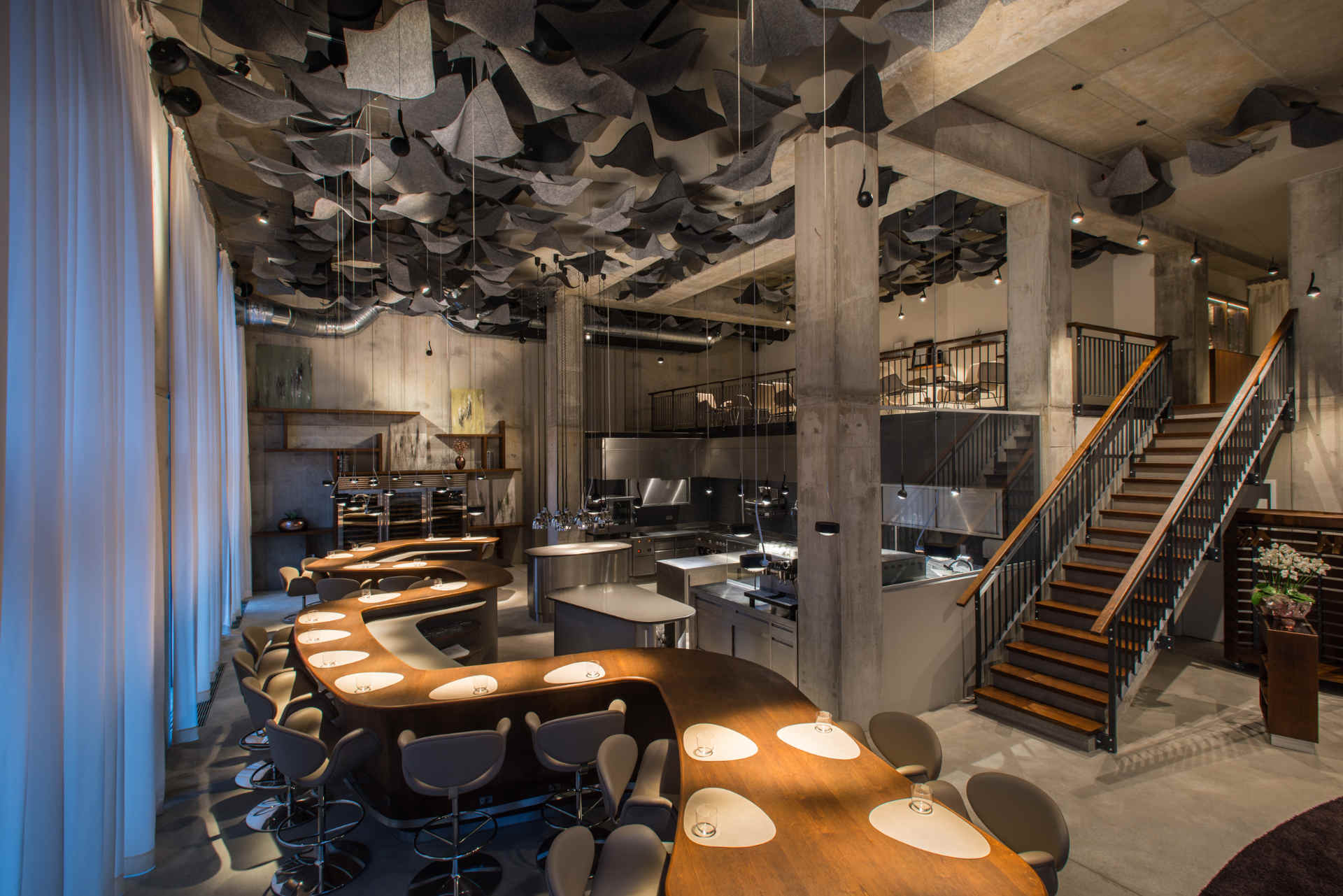
A single curved table, a direct view into the kitchen and a menu that takes you on a journey around the world: at Hamburg’s three-star restaurant The Table, Kevin Fehling has liberated fine dining from its traditional formality. The result is no ordinary evening out at a restaurant, but an extraordinarily rich choreography of cuisine, people, music and atmosphere.
You’ve barely sat down when you realise: this evening is going to be different
Not because three Michelin stars hover over everything at The Table in Hamburg – surprisingly, they don’t at all. But because you suddenly find yourself right in the thick of it. Right in the thick of the kitchen, the service, the conversations, the music and that very special atmosphere that Kevin Fehling has created here. Dishes are being plated up right in front of you, staff are working with intense focus, and there’s a constant flow of communication. You watch, strike up a conversation and, surprisingly quickly, forget that you’re in one of Germany’s most highly decorated restaurants. The Table feels special without ever having to constantly try to be special.
The room itself sets it apart from the classic gourmet restaurant. There are no individual, separate tables. Instead, a single curved table runs through the room, right alongside the open kitchen and its two serving islands. You’re not just sitting somewhere in front of the action; you’re almost right in the thick of it. Kevin Fehling describes this concept as ‘the fusion of kitchen, service and guest’. And rarely does a description fit so well with what you actually experience.
For as the evening progresses, the boundaries do indeed become blurred. The kitchen is not a stage to be viewed with awe from a distance. It is part of the room. The team is present without it turning into a show. And despite all the precision that a three-star restaurant naturally entails, there remains an astonishing sense of lightness. You spend an evening there that truly captivates you.
Three stars without a gourmet temple
From the very beginning, Fehling wanted to create an alternative to classic fine dining. No cheese, chocolate or bread trolleys, no over-the-top service. Not because he rejects this form of gastronomy – on the contrary – but because it doesn’t fit with this concept. “At some point, I think you get the feeling that you’re sitting in a dining room at my home,” he says of The Table. The restaurant was designed to work just as well in New York or Hong Kong: urban, cosmopolitan and international. Today, this idea seems almost self-evident. When The Table opened eleven years ago, it was far from it. The MICHELIN Guide currently describes the cuisine as creative and international, highlighting precisely this fusion: influences from Asia, the Middle East and South America meet a classic French foundation.
The Table Kevin Fehling
© René Riis
The Sea
© Jürgen Müller
Interior The Table Kevin Fehling
© Sven Schomburg Photography
“The Gateway to the World”
The name of the current menu could hardly be more apt: “The Gateway to the World”. It doesn’t begin with a tentative approach, but with a whole series of small dishes: pie tea shell with unagi, Japanese taco with foie gras, beef tartare with beetroot and sardines, ‘Ei Royal’ and butter chicken bun. It’s already clear at this stage how Fehling thinks. He is less interested in the boundaries between countries and culinary traditions than in the question of which flavours work well together. After that, the menu becomes more precise and focused: carpaccio and tartare of hamachi are paired with apple, buttermilk and yuzu dashi. This is followed by lobster, Norway lobster and amaebi with the flavours of the south of France. Particularly noteworthy are the precise integration of contrasts, the quality of the ingredients and the complex yet harmonious flavours.
Turbot: back on the menu after ten years
The menu becomes particularly interesting where Fehling’s own culinary evolution is evident. A turbot crêpinette is served with Swiss chard, young peas and prawn beurre blanc, complemented by a tart with pea purée, lardo and caviar. According to Fehling himself, turbot had not featured on his menu for around ten years. Now, he says, the idea was good enough to bring it back: with a prawn farce and prawn beurre blanc. This is characteristic of his cuisine. A luxury ingredient on its own does not constitute an idea. Conversely, an outstanding dish does not necessarily have to start with the most prestigious ingredient. In conversation, for example, Fehling speaks enthusiastically about cod and eel. He finds cod particularly exciting from a culinary perspective because it can be presented in completely different ways – raw, marinated or cooked. Eel, on the other hand, can be smoked, grilled or prepared Japanese-style as unagi, and can even be combined with foie gras.
From quail to Challans duck
The menu continues with quail breast and confit leg served with artichoke, grilled leek and sherry vinegar hollandaise, followed by Challans duck breast with kumquat, chicory, pecan nuts and green pepper. Behind this lies a cuisine that, whilst drawing inspiration from far-flung destinations, is built on a solid foundation. Fehling himself describes his style as ‘modern classic’ with a French foundation, yet cosmopolitan. That is perhaps the most apt description. Here, international flair is not merely claimed through a few exotic ingredients. The influences become part of a distinct culinary language.
A dish is finished when there is nothing left to take away
And yet, of all things, the idea of omission is central. Perfection, says Fehling, does not actually exist. You can even ‘ruin a dish’ if you keep working on it. That is why he still particularly likes an old saying: a dish is finished when there is nothing left to take away. In times like these, when fine dining is often defined by the number of its components. At The Table, complexity arises from the precise interplay of what remains.
Saddle of venison, peach and Melba
© René Riis
Interior The Table by Kevin Fehling
© The Table by Kevin Fehling
When food becomes emotional
In conversation, Fehling also speaks of guests who have been moved to tears by certain dishes. For him, this is one of the finest compliments of all. For in that moment, the guest has experienced their very own personal form of perfection. And that is probably exactly what explains why The Table is greater than the sum of its dishes. For us, it was pure goosebumps – and not just once that evening. Fehling conceives the evening as a choreography. The presentation is part of it. The people are part of it. So too are the sounds and the music, which he selects himself.
Dessert – but please, not a quiet one
Even at the end, the kitchen remains true to its style. The citrus cheesecake is served with ginger beer sorbet, vanilla and basil oil. This is followed by petit fours, including blueberry with cantuccini and olive, as well as ‘Raspberry Dream’. According to the menu you photographed, the set menu costs 315 euros. It’s a lot of money. And it’s an evening that deliberately transcends the everyday. But for anyone wishing to understand where haute cuisine can go when classic rituals are questioned without sacrificing culinary precision, you’ll find a remarkable answer here.
GENUSSPUNKT Conclusion
The Table is an experience not to be missed – and not simply because the restaurant has been awarded three Michelin stars. It is an experience worth having because it has achieved something far more difficult: combining the utmost precision with an atmosphere in which one almost forgets that precision exists.
The Table brings together cuisine, service and guests. The open kitchen makes the craftsmanship visible. The menu pushes culinary boundaries. And in doing so, Kevin Fehling achieves something that is by no means a given at this level: you are amazed, you get goosebumps and you feel incredibly at ease. For us, that is the true luxury of this restaurant.