When dessert sets the rules
Jaimy Reisinger reimagines fine dining with her BIJA in Graz
23 October 2026 · Alexandra Gorsche
Twelve chapters, an unusual story and a pâtissière who plays with the conventions of haute cuisine. At BIJA in Graz, sweet techniques meet savoury surprises, music meets light art, and extraordinary dishes meet equally creative cocktail pairings. Jaimy Reisinger transforms her fine-dining pop-up into a culinary Gesamtkunstwerk. And she proves that sometimes the most exciting things begin where the classic rules of the menu end.
Anyone expecting a fine-dining menu featuring an amuse-bouche, a fish course, a meat course and dessert will have to rethink their expectations at BIJA. Here, there is no familiar progression from savoury to sweet. Instead, flavour, textures and emotions shape the course of the evening. A dessert can be savoury, vegetables can take centre stage, and a supposedly sweet creation can suddenly reveal entirely different flavours. The concept behind it is as unusual as it is consistent: patisserie is not seen as the final course, but as a culinary philosophy. With its techniques and extraordinary precision, it forms the foundation for an entire menu. Sweetness and acidity, bitterness, salt and umami are recombined, whilst familiar flavour profiles are challenged.
With ‘Chapter III’, BIJA returned to the Van den Berg Gewürzhaus in Graz from 17 to 19 October 2026. The intimate pop-up took guests on a seven-course journey with additional compliments from the kitchen; on Sunday, a more compact five-course version was served. But anyone who came here just for the food missed the real point.
© Genusspunkt
© Genusspunkt
© Genusspunkt
Less explanation, more experience
The very staging makes it clear that BIJA takes a different approach. Lighting moods change, music accompanies each chapter, and small, carefully designed menus take on some of the role that, in traditional fine dining, the service staff would fulfil. Instead of lengthy explanations for each dish, there are poetic lines, ingredients and space for guests to draw their own associations. Guests are not expected to analyse every component in advance, but rather to immerse themselves in the experience.
It is a remarkable shift in perspective: whilst elsewhere the focus of the service presentation is on provenance, techniques and preparation, at BIJA one’s own impressions are allowed to speak first. This by no means implies less craftsmanship. Rather, it is conveyed differently. Not every culinary refinement needs to be explained before one tastes it. The staging is more reminiscent of an evening at the theatre or a visit to an exhibition than a traditional tasting menu. Music, lighting and poetic texts are not mere decoration, but part of the narrative.
Between Earth, Magic and Twilight
The twelve chapters of this culinary story bear titles such as ‘Fragments’, ‘Earth’, ‘Borders’, ‘Happiness’, ‘Magic’, ‘Courage’, ‘Wanderlust’ and ‘Home’. These terms alone reveal that the focus is less on a traditional sequence of dishes and more on moods and associations. The opening features surprising combinations such as blackberry, celery and elderflower miso. In ‘Earth’, beetroot, raspberry and goat’s cheese come together. The signature creation, Beef Stracciatella, plays with expectations and culinary categories. It becomes particularly exciting when supposedly familiar ingredients are given new roles.
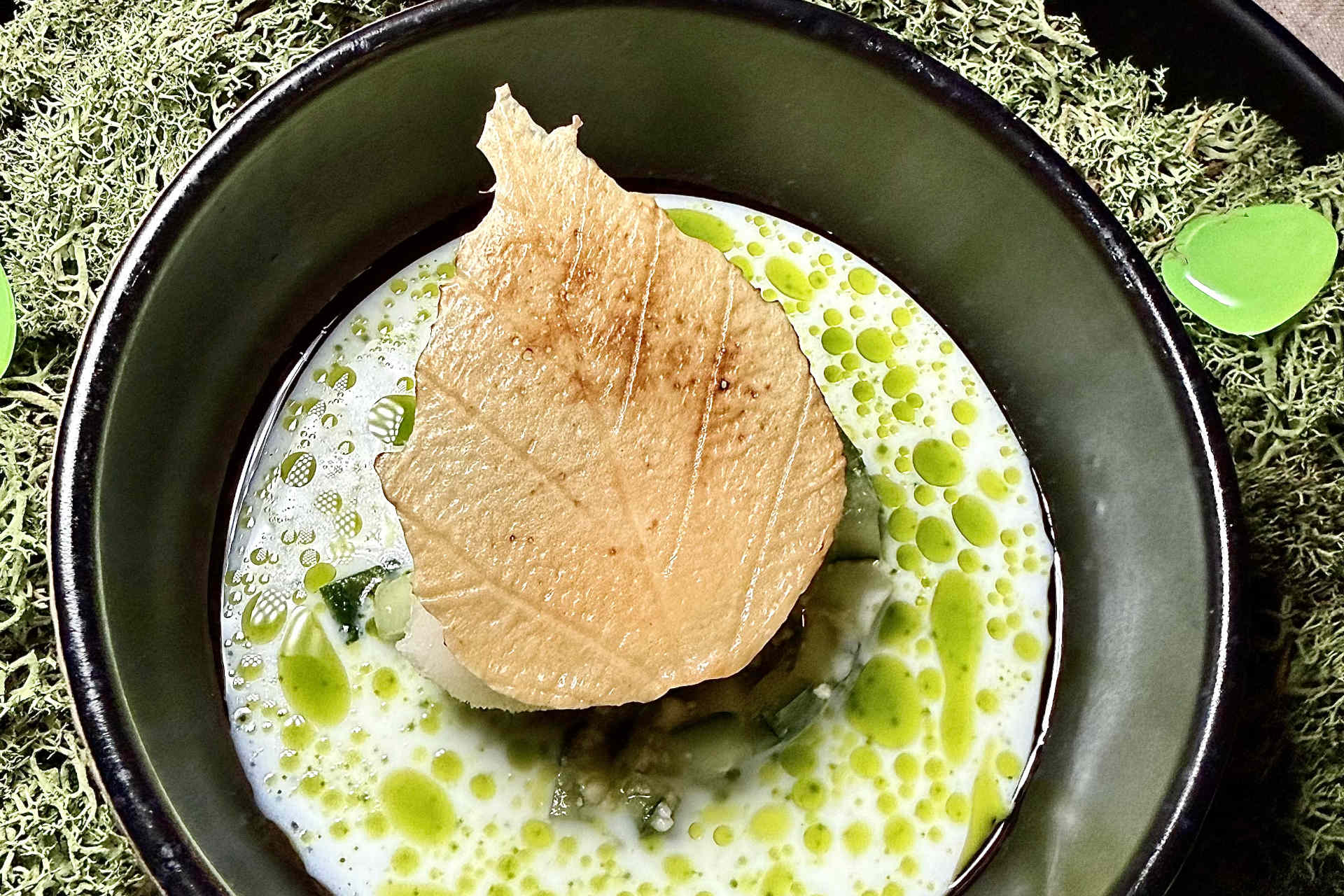
In ‘Magie’, cucumber, lemon, basil and buttermilk combine to create a composition whose freshness and balance of acidity work well even in a dessert context. This is complemented by an atmosphere in which even a glowing cocktail and a disco ball become part of the presentation. ‘Mut’ combines chestnuts, pear and dashi beurre blanc. An unusual encounter of nutty, fruity and savoury-spicy flavours. Dashi, in particular, brings that depth of umami that one would hardly expect in a classic dessert. ‘Fernweh’ (Wanderlust) transports the mind to Asia with sesame, jasmine rice and yuzu. In ‘Zwielicht’ (Twilight), black garlic, strawberry, hibiscus and lime come together. A particularly interesting combination: through controlled heat and humidity treatment, black garlic develops dark, sweetish-spicy flavours that can be reminiscent of dried fruit and balsamic vinegar. This makes it an exciting bridge between savoury and fruity components. ‘Heimat’ (Home), with buckwheat and salted caramel, forms the counterpoint. Familiar flavour profiles appear in a new context.
What’s exciting for us is the fact that this prompts new ways of thinking: why do we perceive certain ingredients as typically sweet or savoury in the first place, and what happens when we break down these mental barriers?
© Genusspunkt
© Genusspunkt
© Genusspunkt
No wine pairings, but a unique drink concept
BIJA also deliberately breaks with traditional expectations when it comes to drinks. Instead of conventional wine pairings, a specially curated selection of drinks is served, featuring both alcoholic and non-alcoholic options. Cocktails and creative drinks are not merely accompaniments here, but another key design element. They draw on ingredients from the dishes, complementing their flavours or creating deliberate contrasts. This is particularly evident in ‘Magie’: bergamot and grapefruit meet a gin from Gölles; the non-alcoholic version features a gin alternative and tonic. The citrus freshness and botanical notes of the drink complement the cucumber and basil composition. In ‘Zwielicht’, on the other hand, the theme of strawberry is taken up and reinterpreted with tomato, lime and rum. The non-alcoholic alternative is based on the same flavour concept.
An exciting, professional approach: a successful pairing does not have to rely exclusively on wine. What matters is the interplay of acidity, sweetness, bitterness, texture and aromatic intensity. Particularly with a menu that oscillates between dessert and savoury dishes, specially developed drinks open up additional possibilities. They can highlight flavours, create contrasts or extend the flavour profile of a course.
A concept with an international flair
It is no coincidence that BIJA plays so effortlessly with the boundaries between sweet and savoury. Jaimy Reisinger’s career path combines creative thinking, classical pastry training and top-class international gastronomy. Her specialisation at Le Cordon Bleu in London and her experience at establishments including CODA in Berlin have broadened her perspective on patisserie. Added to this are years spent in demanding restaurant kitchens, where she was responsible not only for desserts but also for savoury dishes. The strength of the concept lies in Reisinger’s approach, which is not that of a pâtissière who occasionally cooks savoury dishes. She combines both disciplines into a distinct culinary language.
And this certainly calls for courage. For anyone who abandons familiar menu structures also loses their usual point of reference. Not every combination will appeal to everyone, and not every guest will want to miss out on the classic main course. Yet BIJA does not claim to meet everyone’s expectations. Rather, the pop-up demonstrates what contemporary fine dining can look like when the focus is no longer on the sequence of courses, but on the overall experience of the evening. In the end, the question is not so much what constituted the starter, main course or dessert, but rather which moments have stayed in the memory.
© Genusspunkt
© Genusspunkt
© Genusspunkt
Jaimy Reisinger, the woman behind BIJA
From design to the art of flavour: Jaimy Reisinger began her training in graphic design at the Ortweinschule in Graz before deciding to undertake an apprenticeship as a pastry chef through adult education. This was followed by a specialisation in Patisserie Innovation & Wellness at the renowned Le Cordon Bleu in London. Her career has taken her to, amongst others, the CODA Dessert Dining Bar in Berlin, the Artis restaurant in Graz, to work with Hubert Wallner on Lake Wörthersee, and to the Rauch siblings. Her experience in patisserie as well as in the charcuterie department shapes her unusual fusion of sweet and savoury elements. In 2019, at the age of 19, she won the Falstaff Young Talents Cup in the patisserie category. In 2023, she was named Patissière of the Year at the Rolling Pin Convention. With BIJA, she has created her own culinary concept: internationally inspired, executed with precise craftsmanship and deliberately breaking with traditional menu conventions.