Discovering Hamburg on Foot
The Best Sights Between the Port and St. Pauli
21 October 2026 · Alexandra Gorsche
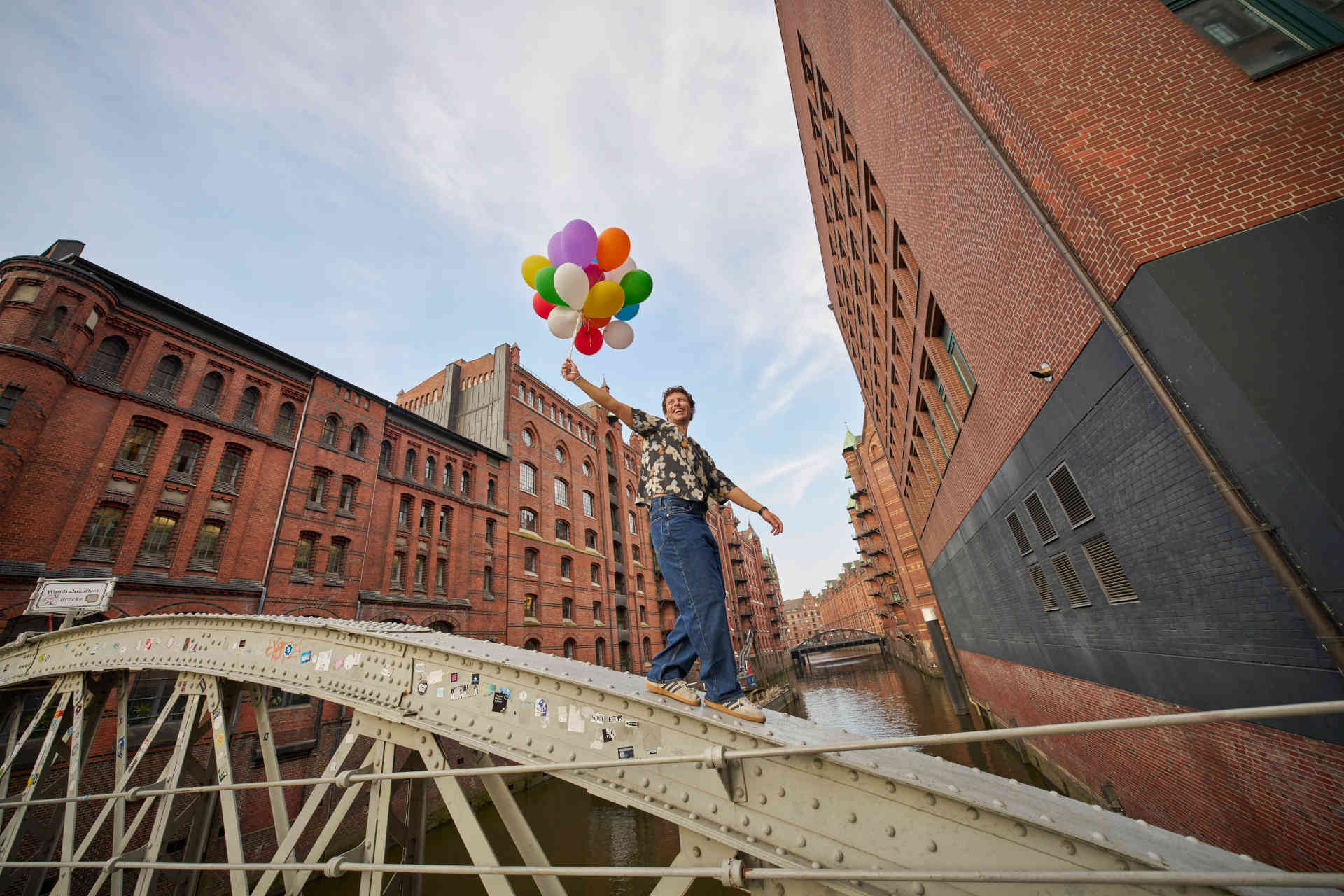
What are the must-sees in Hamburg? Speicherstadt, Elbphilharmonie, and Landungsbrücken are classics, while the Grüner Bunker and St. Pauli showcase entirely different sides of the Hanseatic city. Yet perhaps Hamburg's most beautiful sight is the journey in between: on foot along the water, past red brick, harbor cranes, and the Elbe. A personal sightseeing guide for Hamburg. Hamburg is not a city that shouts at you from every corner: “Look at me.” It makes you work a little, and that is precisely what makes it so appealing. You set off, turn a corner, and suddenly water lies before you. A container ship glides across the Elbe, red brick meets glass, harbor cranes become part of the skyline, and just beyond the next bridge, another perspective is already waiting.
Of course, Speicherstadt, Elbphilharmonie, Landungsbrücken, St. Pauli, and the Grüner Bunker are among the sights in Hamburg that you simply have to see. But after a few days in the Hanseatic city, one thing is clear to me: Hamburg works differently when you experience it on foot and truly immerse yourself in the city's vibe. So: put on some comfortable shoes. Let's go explore Hamburg.
Speicherstadt and Kontorhausviertel: Hamburg's History in Red Brick
Anyone wanting to understand Hamburg should start in the Speicherstadt. Since 2015, the Speicherstadt and the Kontorhausviertel with the famous Chilehaus have been designated a UNESCO World Heritage Site. The Speicherstadt is considered the largest historic warehouse complex in the world and was built on thousands of oak piles starting in the late 19th century.
This architecture is commercial architecture. Here, goods were moved, stored, and traded. Coffee, tea, and spices were among the products that shaped Hamburg's economy and remain closely tied to the culinary history of the port city to this day. Walking through the streets and across the bridges, you don't just witness one of Hamburg's most iconic photo opportunities. You move through a piece of trade history. And often, a short stroll further toward HafenCity is all it takes: historic warehouses suddenly face contemporary architecture. Past and present literally stand side by side here.
© Liggraphy / Pixabay
© Christian Brandes
Elbphilharmonie Hamburg: Concert Hall, Architecture, and Viewpoint
The Elbphilharmonie is both a spectacular concert hall and a piece of urban development made of glass and brick. The architectural firm Herzog & de Meuron placed the new glass structure atop the historic Kaispeicher A. And in truth, this contrast alone tells a great deal about Hamburg: The old does not disappear; it becomes part of something new.
Even the way up is part of the experience. The so-called Tube, an 82-meter-long curved escalator, leads up through the building. At the top, the Plaza awaits at a height of 37 meters, offering new perspectives on the harbor, Speicherstadt, and city center. And right here, you realize: you don't even need to attend a concert to experience the Elbphilharmonie. For me, it is an absolute must-see on a first visit to Hamburg.
© Lacherlott / Pixabay
© Christian Brandes
© Christian Brandes
© Christian Brandes
Landungsbrücken: Pause for a Moment First
The St. Pauli Landungsbrücken are perhaps the most uncomplicated Hamburg moment of all. The floating pontoon complex extends over roughly 700 meters and serves as the starting point for harbor cruises and ferries heading to destinations like Finkenwerder. My advice: don't just hop on right away. Pause for a moment first. Watch the ships. Feel the wind. Take in the hustle and bustle by the water. And definitely grab a Fischbrötchen. Because right here, so many things that make Hamburg unique come together: tourist attraction and authentic harbor infrastructure, everyday life and postcard-perfect scene. And while other places have to build dedicated viewing platforms, here the quay wall is often all you need.
Discovering Hamburg Along the Elbe on Foot: From Landungsbrücken Toward Övelgönne
Hamburg needs movement. It reveals itself especially well along the water. Landungsbrücken, Jan-Fedder-Promenade, Fischmarkt, Övelgönne: with every stretch, the perspective on the Elbe and the port shifts. The Jan-Fedder-Promenade connects Landungsbrücken with Baumwall, running directly along the water. If you have more time and feel like walking, keep going toward Fischmarkt and Övelgönne. Eventually, the harbor panorama turns into the Elbstrand and an almost holiday-like feel. Hamburg Tourism aptly describes the options along the Elbe as “beach hopping”. The beauty of it: you don't constantly have to arrive anywhere. The journey itself is truly part of the sightseeing experience. Ferries glide past, cranes shift along the horizon, and with every kilometer, the city shows a different side.
© Christian Brandes
© Christian Brandes
© Christian Brandes
© Thomas G. / Pixabay
© Lisa Knauer
© Lisa Knauer
Grüner Bunker St. Pauli: Leaving History Visible Instead of Building Over It
The Bunker St. Pauli is one of those places where you should take a closer look. The former flak tower was built in 1942 in just 300 days, with the use of forced laborers. Today, the building blends its difficult history with culture, urban use, and a spectacularly greened rooftop.
A planted, spiral-shaped mountain path leads up along the outside of the building. At the top, a public rooftop garden awaits with 360-degree views across Hamburg. Architecturally, it is fascinating. Even so, the site should not be reduced to just an “Instagrammable rooftop”. The building's history remains part of its identity, and this very juxtaposition is what makes the bunker so intriguing. Today, the Grüner Bunker combines a public roof garden, hotel, dining, culture, and event spaces. From the mountain path, new perspectives on Hamburg open up again and again – including views of the immediately adjacent Millerntor-Stadion, home of FC St. Pauli. Good to know: The walk along the mountain path and access to the rooftop garden are free of charge. A rather spectacular view of Hamburg at zero cost.
© Christian Brandes
© Christian Brandes
© Christian Brandes
© Christian Brandes
St. Pauli: Where Hamburg Gets Louder
At some point in Hamburg, you should also head to where things get a little less Hanseatic and reserved. St. Pauli is nightlife, clubs, bars, soccer, subculture, and music history – its own distinct microcosm within the city. And walking down the Große Freiheit today means treading on internationally significant musical ground. On August 17, 1960, a crucial chapter in the history of the Beatles began at Indra. The then largely unknown band played numerous gigs in the clubs of St. Pauli during their time in Hamburg; the city became a milestone in their early development.
Knowing this changes how you walk through these streets. Suddenly, St. Pauli is not just a nightlife district, but a piece of international music history. And that is precisely what I love about Hamburg: behind places you think you know, a second story is often waiting to be discovered.
© Bernd Hildebrandt / Pixabay
© Francesco Ronge / Pixabay
Hamburg Is at Its Best Between the Sights
Perhaps the most important takeaway after these days: Hamburg should not be experienced purely through a checklist.
Elbphilharmonie: checked.
Speicherstadt: checked.
Bunker: checked.
That would be a shame. Because often it is the moments in between that stay with you: a ferry gliding across the Elbe. Seagulls above Landungsbrücken. Red brick in the evening light. Harbor cranes on the horizon. A Fischbrötchen by the water. A drink in St. Pauli. Or that one street that suddenly opens up to reveal a view of the Elbe. One thing is certain: Hamburg will see us again.