Haute Cuisine on Lake Wörthersee Between Carinthia and Alps-Adriatic
An Interview with Hubert Wallner
17 September 2026 · Alexandra Gorsche
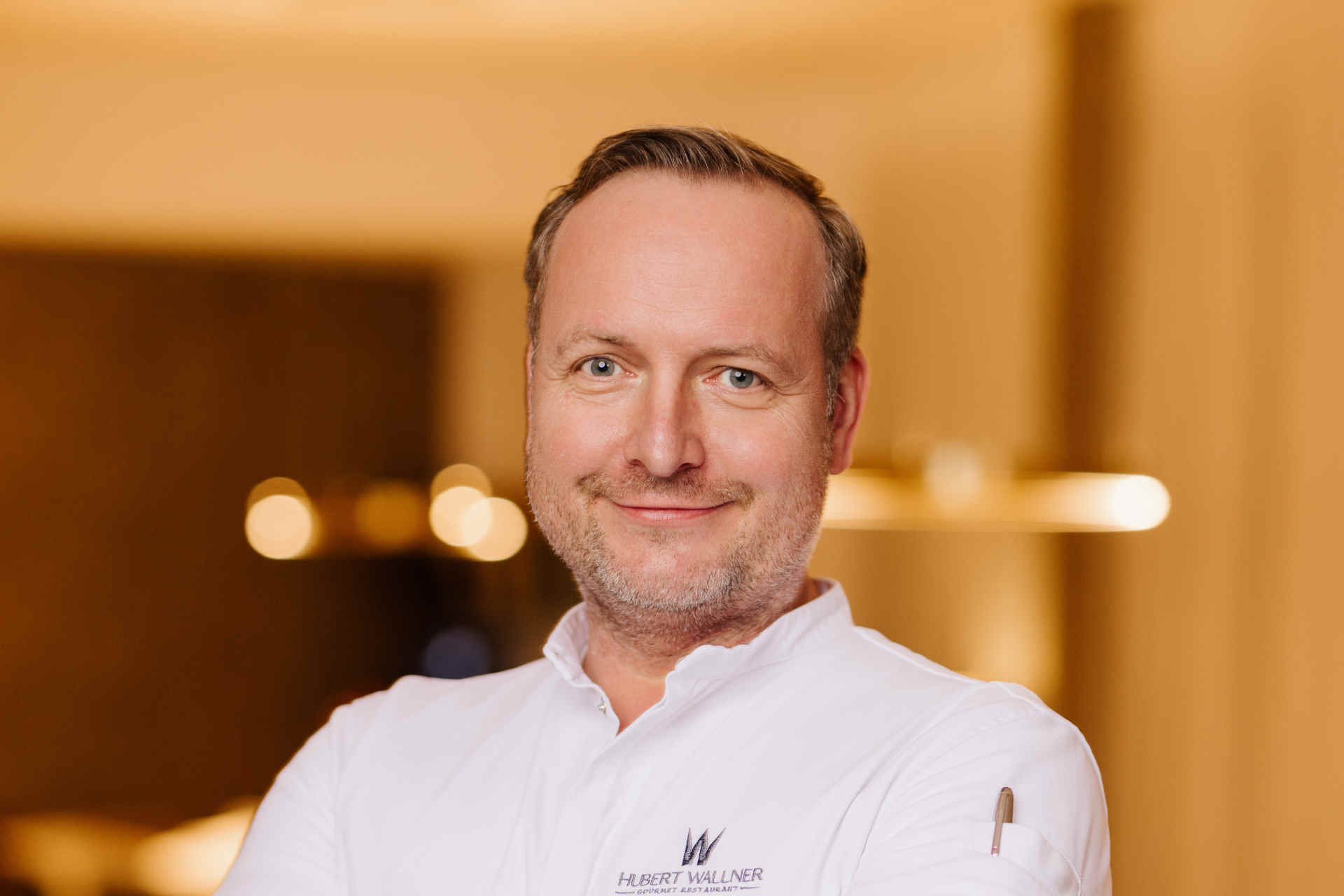
How do you stay relevant in high-end gastronomy for years without betraying your own signature style? Hubert Wallner is one of Carinthia’s defining chefs and has long created much more than just an award-winning restaurant around Lake Wörthersee. Fine dining, bistro, bar, water taxi, and chalets make up a small universe of indulgence that brings together culinary art, the region, and unique experiences.
In an interview with GENUSSPUNKT, Wallner explains why a good idea alone doesn’t make a good concept, why of all things Grießkoch with vanilla ice cream is his personal soul food, and why the Reinanke from Lake Wörthersee is one of the region’s most underrated products in his eyes. And he touches on something that sounds almost provocative in an industry constantly chasing the next trend: Perhaps you don’t need to constantly reinvent yourself. Perhaps, above all, you just need to know what you stand for.
A Culinary Universe Around Carinthia and Lake Wörthersee
Hubert Wallner’s signature style is no longer confined to a single restaurant. His diverse venues combine upscale dining with extraordinary locations and deep roots in Carinthia and the Alps-Adriatic region. At the Michelin-starred Restaurant Hubert Wallner, fine dining meets the immediate shores of Lake Wörthersee; Bistro Seensucht translates regionality and Mediterranean influences into a more relaxed setting. With the Südsee Bootstaxi, even the trip across Lake Wörthersee becomes part of the experience, while the Circle Chalets am Arlberg offer a retreat in the heart of nature. Added to these are other concepts such as Bistro George and the Sky-Bar Marie in Klagenfurt. What might seem very disparate at first glance follows a single unifying idea: Quality, regionality, and hospitality shouldn’t be bound to a single format. Sometimes that means fine dining, sometimes bistro dishes, sometimes a drink with a view or a boat ride across the lake. That is precisely what we talked to Hubert Wallner about.
“An Idea Needs Passion and a Little Bit of Courage”
ALEXANDRA GORSCHE: Hubert, a Michelin-starred restaurant, bistro, bar, water taxi, chalets: How do you maintain an unmistakable identity when approaching dining and hospitality through such diverse concepts? And what does it take to turn an idea into a truly functioning concept?
HUBERT WALLNER: I have plenty of ideas—very, very many. But I think you need the necessary passion and a bit of courage to actually put those ideas into practice. And then you need team members who think like the entrepreneur. Fortunately, we have that. That’s how an idea ultimately becomes reality.
“When I need to unwind, I cook Grießkoch”
You often feature dishes and flavors tied to personal memories. Which dish immediately takes you back to your childhood?
My father used to make Grießkoch for me. To this day, it’s a dish I love to make myself and one I always loved cooking for my children. When I come home stressed and need to unwind, I cook myself a Grießkoch, maybe add a scoop of vanilla ice cream, and think of my father. That’s something that gets me daydreaming and reminiscing. It simply hits home for me.
So that means the Hubert Wallner version of Grießkoch comes with vanilla ice cream?
Yes, exactly.
Reinanke from Lake Wörthersee: “Completely underestimated by many chefs”
Is there an ingredient you feel is completely underestimated that you particularly enjoy working with?
Yes, the Reinanke from Lake Wörthersee. Of course, it’s not a fillet from a three- or four-kilo wild turbot. But you can do so much with Reinanke: really good ceviche, for instance, or even sushi. I consider myself very fortunate that we get it freshly caught from Lake Wörthersee. To me, it’s a magnificent product that is completely underestimated by many chefs.
And Reinanke has also become one of your signature dishes. How do you prepare it?
We poach it in brown butter. We serve it with leaf spinach and Malabar spinach, horseradish foam, some fresh horseradish, and toasted bread croutons. Actually quite simple, but it leaves you wanting more.
If you had to put Carinthia on a plate: What does “Carinthia on a plate” mean to you?
To me, it means genuine authenticity above all. We have sensational produce and ingredients in Carinthia. For me, Carinthia is authentic, pure, and sustainable.
At the same time, Carinthia is located right in the Alps-Adriatic region. How much Alps and how much Adriatic is in your cuisine?
We try to incorporate a great deal from the entire Alps-Adriatic region into our menu. Our ratio is roughly 60 percent fish and 40 percent meat. With vegetables, too, we make sure to work with regional suppliers to reduce transport routes. At the moment, for instance, we have lamb from the Großglockner on the menu—a sensational product.
“You have to stay true to your line”
Gastronomy is changing at incredible speed. How do you manage to stay relevant over many years?
It definitely takes a great deal of perseverance. In the past, I used to say you had to constantly reinvent yourself a little. Today, I think that’s complete nonsense.
You should stay true to your line.
When you do what you do with passion and conviction, and manage to inspire your team to share that, the guest feels it. I believe that is precisely how you remain relevant for years.
You had great mentors yourself. Is there a piece of advice or mindset from that time that stays with you today?
One of my most important mentors was certainly Martin Sieberer. He inspired me deeply with his down-to-earth nature. Martin always said: “You have to keep both feet firmly on the ground. You must never forget where you come from.” My father taught me something similar. He used to say: “Arrogance is where you need a parachute.” I want to pass this attitude on to my children and my employees as well. Today, you also need to take the time for your staff and actively engage in dialogue. And something else I learned from Martin is calm. No matter how stressful things got, he possessed this inner calm. That leaves a lasting impression on you.
You’re not just a head chef; you approach your dishes with tremendous creativity. When do you consider a new creation truly successful?
When it stays in your memory. If you’re still talking about it and raving about it a few days later, then a dish is perfect to me. It can even be something quite simple. A dish doesn’t need 17 elaborate steps. Usually, three are enough. The simpler, the better. But if it is simple, it simply has to be cooked to perfection.
“The best thing would be if, as you say goodbye, you’re already looking forward to your next visit”
What feeling should a guest leave your restaurant with at the end of the evening?
The greatest thing would be if, when saying goodbye, you’re already looking forward to your next visit. If you feel that we surprised you and struck the right chord, that you felt well taken care of with us, and that we touched you with our food. Because for me, dining time is also lifetime. Putting the phone away for a while and reflecting on what you have. My father always said: even in times of crisis, people come together at the inn. I think we should reflect on that more, as well as on all the good things we have here in Austria that many envy us for. Sometimes it’s the most ordinary things: you turn on the tap and you can drink the water. We should appreciate things like that more consciously again.
To close: So many different concepts, yet one signature style. Hubert Wallner in three words?
Authentic. Honest. Sustainable.
Our Conclusion
Perhaps that is precisely what is so compelling about Hubert Wallner’s answer to the question of long-term relevance: not chasing after every trend, but honing your own line with ever-greater precision. The Reinanke doesn’t have to become turbot. A dish doesn’t need 17 elaborate steps. And a simple Grießkoch can become a lifelong memory. Because in the end, what stays in our minds in gastronomy isn’t necessarily the most complicated, but what touches us.