Too much art for a business?
What happens when a chocolatier chooses to follow his intuition rather than a business plan?
19 October 2026 · Alexandra Gorsche
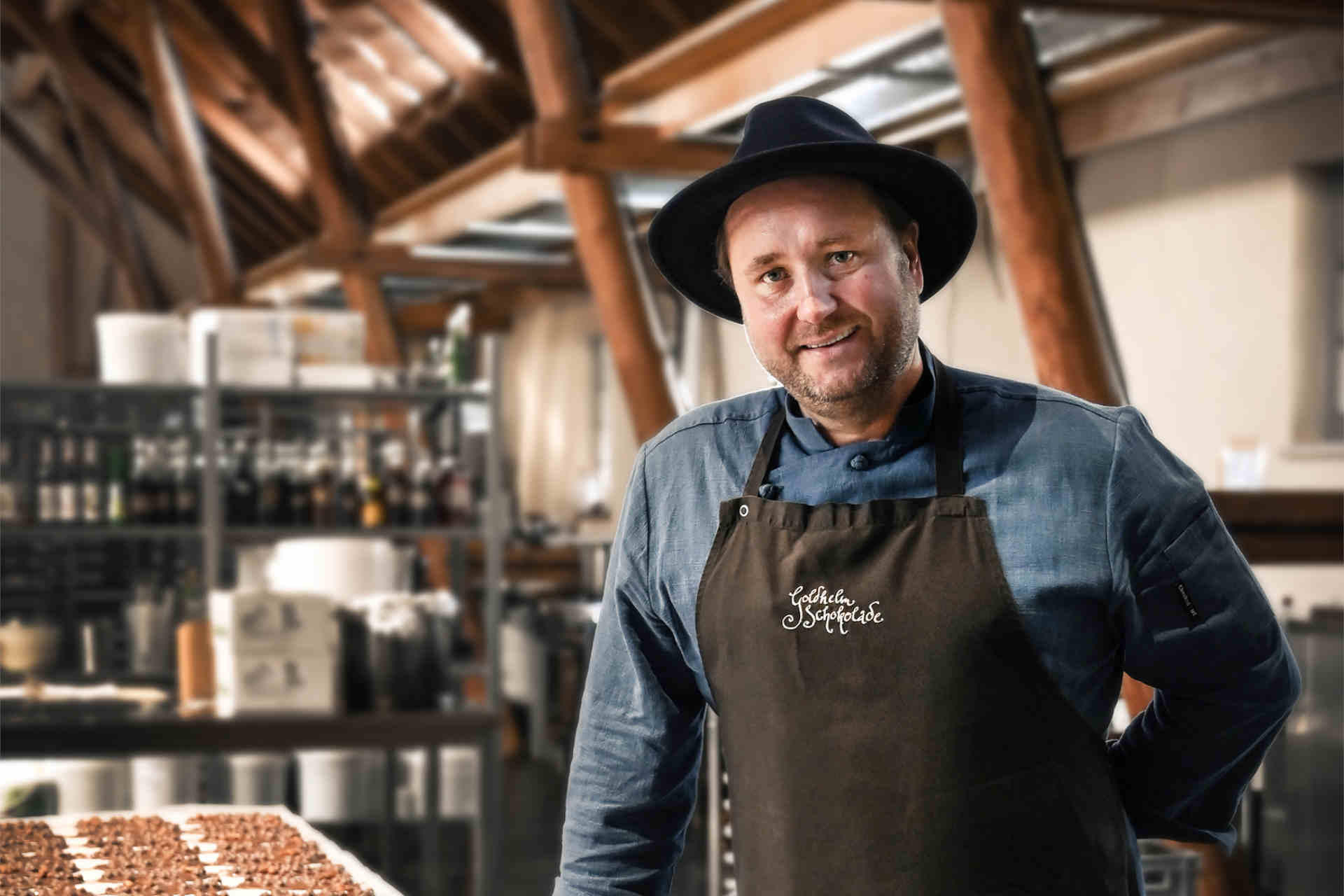
With Goldhelm, Alex Kühn has created an extraordinary world of indulgence from a marble slab he was given. He transforms cocoa beans into taste experiences, illustrations into stories, and a workshop into a place brimming with life. A fascinating story of how artistic freedom turns into entrepreneurial success. And why his unmistakable signature style even graces the cover of the 03/2026 issue of GENUSSPUNKT.
A start with pink pepper
In the historic building ‘Zum Güldenen Helm’, Kühn moulded his first bars on a marble slab that a friend had given him. He wrapped them in paper that he had painted himself. There was no money for a graphic designer. Initially, he also stocked chocolates from well-known chocolatiers. When customers began choosing his own creations instead, the experiment turned into a viable venture.
The trained graphic designer had previously worked as a chef and played music. For a long time, he searched for an occupation that would combine all his interests. He found it in chocolate: recipe development, craftsmanship, drawing, and meeting people. “I just do things as I go along”, he explains in an interview with GENUSSPUNKT. His ideas tend to come not so much at his desk as whilst travelling, eating and interacting with people.
Alex Kühn
© Goldhelm
In the design process
© Goldhelm
From bean to flavour
Since 2018, Kühn has been travelling regularly to cocoa-growing regions, selecting beans in person and overseeing their processing. Goldhelm works as a chocolatier and chocolate maker: not only does he create pralines and bars, but the chocolate itself is crafted from the bean. This makes a crucial difference to the flavour. The variety and origin determine a cocoa’s potential; fermentation and drying influence the development of its preliminary flavour notes. During roasting, further notes emerge, ranging from fruity and floral to nutty or earthy. Grinding, refining and conching ultimately shape the texture and mouthfeel. Goldhelm processes the mass to a particle size of less than 30 micrometres, ensuring a smooth melt that releases flavours without any unpleasant graininess.
His regional chocolates demonstrate just how deeply he is interested not only in the raw materials themselves, but also in their stories. For an early Hiddensee creation, Kühn brought along sea-buckthorn juice he had collected himself. The encounter with a friend who supplied him with particularly intense juice remains just as much a part of his memory as the taste itself. “A great many chocolates come about through encounters”, says Kühn. For him, provenance is more than just an address on the packaging.
“So many chocolates are born out of encounters.”
A farm full of ingredients
The Goldhelm Chocolate Farm is situated in Wülfershausen, around 20 kilometres from Erfurt. Since 2020, the renovated four-sided farmstead has combined production, development, ice cream and beer brewing, retail and catering. The surrounding land is home to currants, tomatoes, herbs, flowers, grapevines and hazelnuts; the farm’s own gardener oversees the cultivation. In 2023 alone, 1,200 hazelnut bushes were planted. This proximity to the ingredients is significant from a culinary perspective: the degree of ripeness and the harvest time can be determined more precisely, whilst delicate fruits and herbs can be processed quickly. The farm’s own harvests are used, for example, in fruit-based creations; in the longer term, further raw materials for nougat and chocolates are to come from the farm. This approach is reminiscent of high-quality restaurant cuisine: not just telling the story of the ingredients’ origins, but making them tangible through flavour.
Chocolate Manufactory
© Goldhelm
Goldhelm Gastronomy
© Goldhelm
Goldhelm Gastronomy
© Goldhelm
Saddle of venison and truffle pizza
© Goldhelm
Flavour takes on a face
Every Goldhelm bar bears Kühn’s distinctive style. His illustrations are not merely an afterthought, but an integral part of the recipe concept. A customer once told him: “Just by looking at your pictures and your packaging, you can already tell what the chocolate tastes like.” For him, this is one of the finest compliments. Vibrant colours, bold lines, whimsical figures. They evoke associations even before the first piece touches your tongue. Kühn’s drawings have since been the subject of an exhibition in Dresden. The same principle characterises his shops in Erfurt, Leipzig and Berlin: warm apricot tones, white furniture modelled on old French pharmacies, and an atmosphere more reminiscent of a salon than a standardised retail space. Even in his very first shop, despite a tight budget, Kühn had a wall knocked through so that guests could see into the kitchen. The craftsmanship was meant to be on display.
A treat that goes beyond the table
Goldhelm also produces NaturEis, without any ready-made powders, artificial flavourings or preservatives. Organic milk, fruit, homemade chocolate, nougat and caramel form the basis for flavours with names such as ‘Peru Jungle Cocoa’, ‘Captain’s Caramel’ or ‘Granny Ulla’s Dessert’. This playful approach is characteristic: good products should not only taste good, but also spark curiosity. At the Schokoladenhof, this idea is brought to life through genuine hospitality. The Flamberie combines an open kitchen, a pizza oven, an open fire and cosy seating areas beneath historic half-timbered walls. Anyone dining here also experiences the very place where the ingredients are processed. For the hospitality industry, this holds an important insight: atmosphere influences how we perceive flavour and what we remember from our visit.
Goldhelm Ice Cream Parlour
© Goldhelm
Selection in Berlin
© Goldhelm
Shop in Berlin
© Goldhelm
Growing without losing focus
With nearly 200 staff, as Kühn explains in the interview, what was once a one-man project has become a complex business. The challenge: in the past, he could develop a flavour and sell it the very next day; today, planning and distribution require longer lead times. That is why he is considering exclusive small batches for his own shops – perhaps just a hundred or three hundred bars. This would leave room for spontaneous ideas, even if not every one is suitable for large-scale distribution.
His example shows that a strong gourmet brand needs more than just skilful storytelling: it needs its own distinctive style, consistent craftsmanship and experiences that are genuinely worth sharing. For Kühn, the benchmark here is not the fastest possible growth, but the joy of the work and the freedom to keep dreaming.
You can taste, see and now even open this attitude: Alex Kühn drew the cover of the GENUSSPUNKT issue 03/2026 especially for us. An original that readers already hold in their hands before they read his story. After all, enjoyment sometimes begins long before the first bite.