Kwame Onwuachi on street food, fine dining, authenticity and the power of forging your own path
Interview with the James Beard Award-winning chef behind Tatiana in New York, Dōgon in Washington, D.C., and his expanding Afro-Caribbean culinary universe
30 April 2026 · Alexandra Gorsche

For Kwame Onwuachi, food is never just food. It is memory, movement, migration, culture, place, and personal truth served on a plate. The James Beard Award-winning chef, restaurateur and author has built a culinary language rooted in New York City, Nigeria, Louisiana and the Caribbean. He has made him one of the most influential voices in contemporary American dining.
His restaurant Tatiana in New York City was named the “#1 Restaurant in New York” by The New York Times two years in a row, while Dōgon in Washington, D.C. has quickly become one of the capital’s most talked-about restaurants. His official biography also lists him as one of TIME’s 100 Most Influential People of 2025.
In this conversation, Onwuachi speaks about why street food already belongs in the realm of fine dining, how to honor a dish without stripping away its identity, what authenticity really means, and why young chefs should stop chasing the destination and start respecting the journey.
Interview: Kwame Onwuachi on Flavor, Culture and the Future of Authentic Food
What makes a simple street food dish worthy of fine dining?
I think street food is already worthy of fine dining. If you break down the ingredients of a taco on the side of the road in Guadalajara, there is just as much effort in that as there is in fine dining. Within fine dining, of course, you take into account all the extremities of the experience: the guest experience, making sure guests want for nothing, the temperature of the room, the upkeep of the bathrooms. But at the end of the day, food is food. If you are putting in the effort and meeting that effort with flavor, then you can take that same dish that is served on the side of the road, put it in a fine dining restaurant, and voilà - it is fine dining.
How do you elevate a dish without losing its original identity?
That is the thing: you do not cook for fine dining. You cook for flavor. You cook with respect for the dish, especially if you are taking it out of its original element from the street into another kind of space. You should honor it instead of trying to make it “better,” because you cannot. The dish already comes from somewhere. If you are choosing to work with it, that means someone is already doing something that you could not have created from nothing. You are not creating something completely original. You are taking something that exists and formulating it through the way you see food. Instead of asking, “How do I elevate this?” you ask, “How do I make it mine?” That is how you can transform a dish without taking away what makes it powerful in the first place.
When was the last restaurant visit that made you think: “Wow”?
I went to Lotus of Siam in Las Vegas. It is a Thai restaurant. I had khao soi, which I believe is a dish from northern Thailand. The first time I had that dish was in Chiang Mai, and when I had it at Lotus of Siam, I thought: “Wow, this is the best version of this dish I have ever had.” It was absolutely amazing.
Las Vegas is becoming more and more exciting as a food city. How do you see it?
I think Las Vegas is an amazing town for food. I am opening a restaurant there next month, a Caribbean steakhouse. [Update: Maroon at SAHARA Las Vegas opened in May 2026.]
“You don’t cook for fine dining. You cook for flavour. You cook with respect for the dish, especially when you take it out of its original setting – for example, from the street into another room.”
Looking ten years into the future: what will define authentic food, and who decides what is authentic?
Authenticity is in the eye of the beholder. If you go to Mexico and you go into someone’s house and have mole, I am sure that if you go next door, it will be a different mole. If you go to Jamaica and have oxtails, then go to the next house, those oxtails will be different too. Authenticity lies within what you know best, with respect to the culture.
I do not think you can be from another culture, have something once, and then claim that you know what it is supposed to taste like. But if you have lived in a region long enough, or if you grew up eating something consistently, then that is the way it is authentic to you. As long as you can stand behind that, I think that leads the charge. Tacos de canasta are different from tacos in Guadalajara. So which one is authentic? It depends on the region, on the people who eat it constantly, and on the time they have put into it. Making sure you are telling the story is so important. Making sure you can back that story up is even more important.
You are not only a chef, but also a leader. What makes a good leader?
Thinking that you are never a leader. A good leader knows how to follow. So I follow, and people follow me.
What advice would you give to young chefs?
The journey is the reward in anything you are doing. Have a focus on the North Star, but do not think that when you get there, you are suddenly going to have this big “aha” moment. The aha moment comes through the journey. Enjoy the journey.
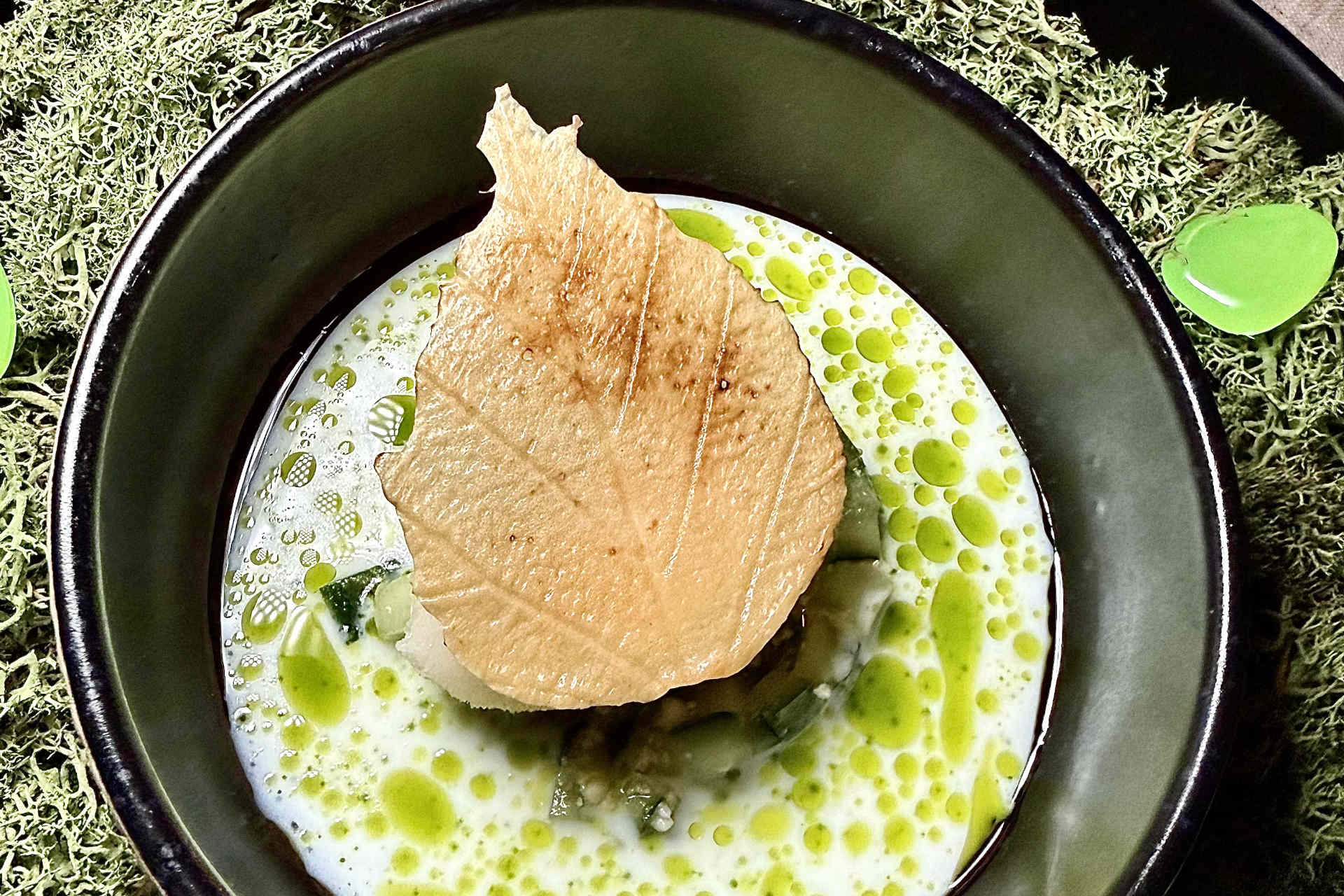
Red snapper and banana leaf
© Scott Chebegia
Agnolotti with curried goat
© Scott Chebegia
Tablescape
© Scott Chebegia
Oxtail Wellington
© Scott Chebegia
Alexandra Gorsche and Kwame Onwuachi
Editorial note
This interview was conducted by Alexandra Gorsche, an international moderator, speaker, business consultant, influencer and journalist, as part of the Future Menus 4 presentation in the Netherlands. With her expertise in food, hospitality, communication and culinary trends, Alexandra Gorsche regularly connects leading voices from the industry with audiences across media, events and digital platforms.
Infobox: Who Is Kwame Onwuachi?
Name: Kwame Onwuachi
Profession: Chef, restaurateur, author
Cuisine: Afro-Caribbean, West African, American, Creole and diasporic culinary storytelling
Known for: Tatiana in New York City, Dōgon in Washington, D.C., Patty Palace by Chef Kwame
Awards and recognition: James Beard Award winner, Food & Wine Best New Chef, Esquire 2019 Chef of the Year, Zagat and Forbes 30 Under 30 honoree, TIME 100 Most Influential People of 2025.
Background: Raised between New York City, Nigeria and Louisiana, Onwuachi’s cooking is deeply influenced by his ancestors, his upbringing and the foodways of the African diaspora.
Restaurants and projects: Tatiana in New York, Dōgon at Salamander Washington DC, Patty Palace by Chef Kwame at Citi Field, Las’Lap Miami and a partnership with SAHARA Las Vegas.
Signature philosophy: Food should carry flavor, story, culture and purpose — not just technique.