Leadership on the High Seas
Father and Son on the Path to Success
Advertorial · 23 November 2026
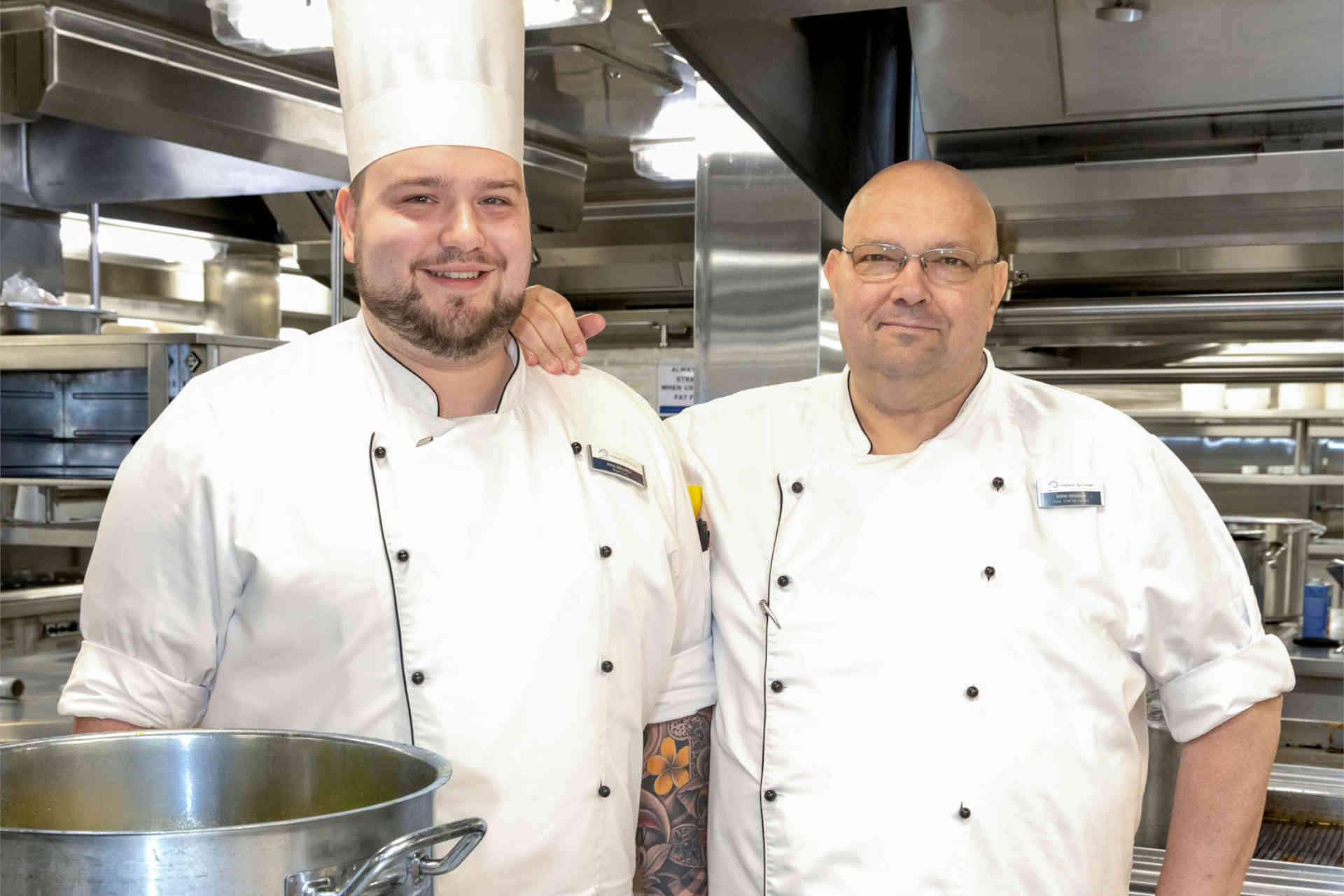
When years of experience meet fresh perspectives, a special partnership is born: Bodo and Paul Diedrich, father and son, work side by side in the galley on board the Mein Schiff® fleet. Bodo has been with sea chefs since 2013 and is now Executive Chef. Paul started in February 2025 as Chef de Partie and is now Sous Chef. In this interview, the pair talk about how they lead an international kitchen team, the responsibilities that come with their roles, and why working and living at sea offers unique opportunities for personal and professional development.
How did it come about that you’re now working together on board?
Paul: When my father started at sea chefs in 2013 and went to sea, I thought it was absolutely brilliant and wanted to do it myself one day. Twelve years and a fair bit of personal growth later, the time had come: in February 2025, I started on board as a chef de partie and now work as a sous chef.
How does it feel, as father and son, to share responsibility for a galley on board?
Bodo: It’s an intense mix of blind trust, family dynamics and hard, disciplined teamwork.
Paul: Of course, our family bond plays a part. But first and foremost, we’re here to work. In our day-to-day work, therefore, it’s all about focused, disciplined and goal-oriented collaboration.
What makes your collaboration special?
Bodo: I pass on my many years of experience and bring the classical approach to the table. Paul focuses on new techniques and current trends and enjoys trying things out.
Paul: I think it’s precisely this mix that makes our collaboration special. My father brings a wealth of experience, whilst I contribute new perspectives and ideas. That way, we can learn from one another and complement each other.
What does good leadership mean to you – particularly in an international kitchen on board?
Bodo: Above all, good leadership means clear and straightforward communication, mutual respect and a strong sense of team spirit that transcends all language and cultural barriers.
Paul: To successfully lead an international kitchen team, you need patience, tolerance, cultural open-mindedness, resilience and human warmth. At the same time, you must be able to give clear instructions. Especially in stressful situations, it’s important to keep a cool head and listen to the team.
How has your understanding of leadership changed over time?
Bodo: Our understanding of leadership has evolved over the years. Today, we place greater emphasis on collaborative partnership, as well as trust, empathy and personal responsibility.
Paul: It’s not just about assigning tasks and monitoring their completion. A good leader should know the team, understand different personalities and support staff in taking responsibility for themselves.
What distinguishes managing a kitchen team on board from working in a kitchen on land?
Paul: On board, we work in a confined space and the ship is constantly on the move. On top of that, the composition of the team can change, and we’re constantly seeing new personalities, nationalities and cultures coming together. That calls for clear and straightforward communication – and sometimes a bit of tact.
The availability of supplies is also different. There’s no such thing as a spontaneous trip to the shops in between shifts. Everything we need for upcoming voyages has to be planned well in advance.
Another difference is that you don’t go home after your shift. You continue to meet your colleagues on board in your free time and are often still on call. That’s why managers must keep an eye not only on the processes in the galley but also on the well-being of their crew.
© TUI Cruises
© TUI Cruises
As Executive Chef and Sous Chef, what are you responsible for apart from cooking?
Bodo: Our responsibilities include, amongst other things, staff planning, stock management, quality control and monitoring hygiene regulations. In addition, we train and mentor crew members and support them in their development.
We pass on our experience through traditional mentoring, regular meetings and documentation. In group discussions, we can openly discuss what has worked well, where there have been challenges and what we can learn from them.
What sort of people fit particularly well into the team?
Bodo: People who are open-minded, helpful and motivated, who enjoy working in a team and contribute their own ideas.
Paul: Hard work and team spirit are also important. In an international team, you should be open to engaging with other people and cultures and be prepared to adapt to different ways of working and personalities.
How can you tell if someone is ready to take on more responsibility?
Paul: Above all, by the fact that the person solves problems on their own initiative, acts proactively and owns up to their own mistakes. Anyone who doesn’t just wait for instructions, but thinks for themselves, takes responsibility and learns from their mistakes, demonstrates significant leadership potential.
Why is working on board a good place to develop professionally?
Paul: On board, you work in a dynamic and international environment and are faced with new, as well as recurring, challenges every day. This teaches you to be adaptable, to work as part of a team and to find solutions even in demanding situations. As a result, you develop very quickly, both professionally and personally.
What career progression opportunities are there in the ship’s galley?
Bodo: In the galley, there’s a clear career path through various roles – from cook, through chef de partie and sous chef, right up to executive chef. Anyone who’s motivated, performs well and is keen to take on responsibility can progress step by step whilst on board.
Paul: My own journey shows that this progression is possible. I started as a chef de partie and now work as a sous chef. In doing so, I’ve been able to gain a lot of new experience in a short space of time and take on more responsibility.
What are you each particularly proud of in the other?
Bodo: I’m proud of how Paul pursues his goals and develops both professionally and personally. It’s lovely to see him forge his own path and achieve his goals and dreams.
Paul: I’m particularly proud of how long my father has been working for the company and the reputation he’s built up over that time. I’m very impressed by his experience and what he’s achieved over the years.
What have you learnt from each other during the time you’ve spent together?
Bodo: We’ve learnt to clearly express our needs and the things that are on our minds, rather than waiting for the other person to pick up on them by themselves.
Paul: We’ve also learnt to listen more effectively – not just to reply straight away, but to really understand the other person. That includes putting ourselves in the other person’s shoes and looking at situations from their point of view.
Which destination has left a particularly lasting impression on you?
Paul: For me, it’s Norway. The mountains, fjords, lakes, small towns and even remote islands like Spitsbergen make the country special. The landscape is incredibly diverse and never ceases to impress me.
What inspires you about living and working on board?
Bodo: Even after many years, I’m still inspired by the constant variety, the strong camaraderie amongst the crew and the fascination with the sea. Added to that is that special feeling of freedom.
Paul: I haven’t been here for very long, but what I love most of all are the changing destinations, the team spirit within the department and, of course, the sea. No two assignments are exactly the same, and you gain a great deal of varied experience in a short space of time.
What advice would you give to chefs who would like to take on a leadership role themselves?
Bodo: The most important thing is to keep your cool even in stressful situations, to communicate clearly and, first and foremost, to listen. A manager should lead by example every day with a positive work ethic and punctuality, thereby setting a standard for the team.
Before changing procedures, you should get to know the people in the team and how they work. Instructions must be calm, clear and easy to understand. At the same time, you should treat all staff with respect and treat them with dignity, regardless of their position or background.
Paul: I also think it’s important to first understand and analyse the team before trying to change anything. If an instruction isn’t understood straight away, you should demonstrate the step and carry it out together with the crew members. To me, good leadership also means treating all staff in the galley equally and not favouring anyone.
How would you describe your working relationship in three words?
Bodo: Reliable, open and goal-oriented.
Paul: Focused, disciplined and goal-oriented.