“We are service providers, but not servants”
Enrico Ungermann on new leadership in the hospitality industry
03 October 2026 · Alexandra Gorsche
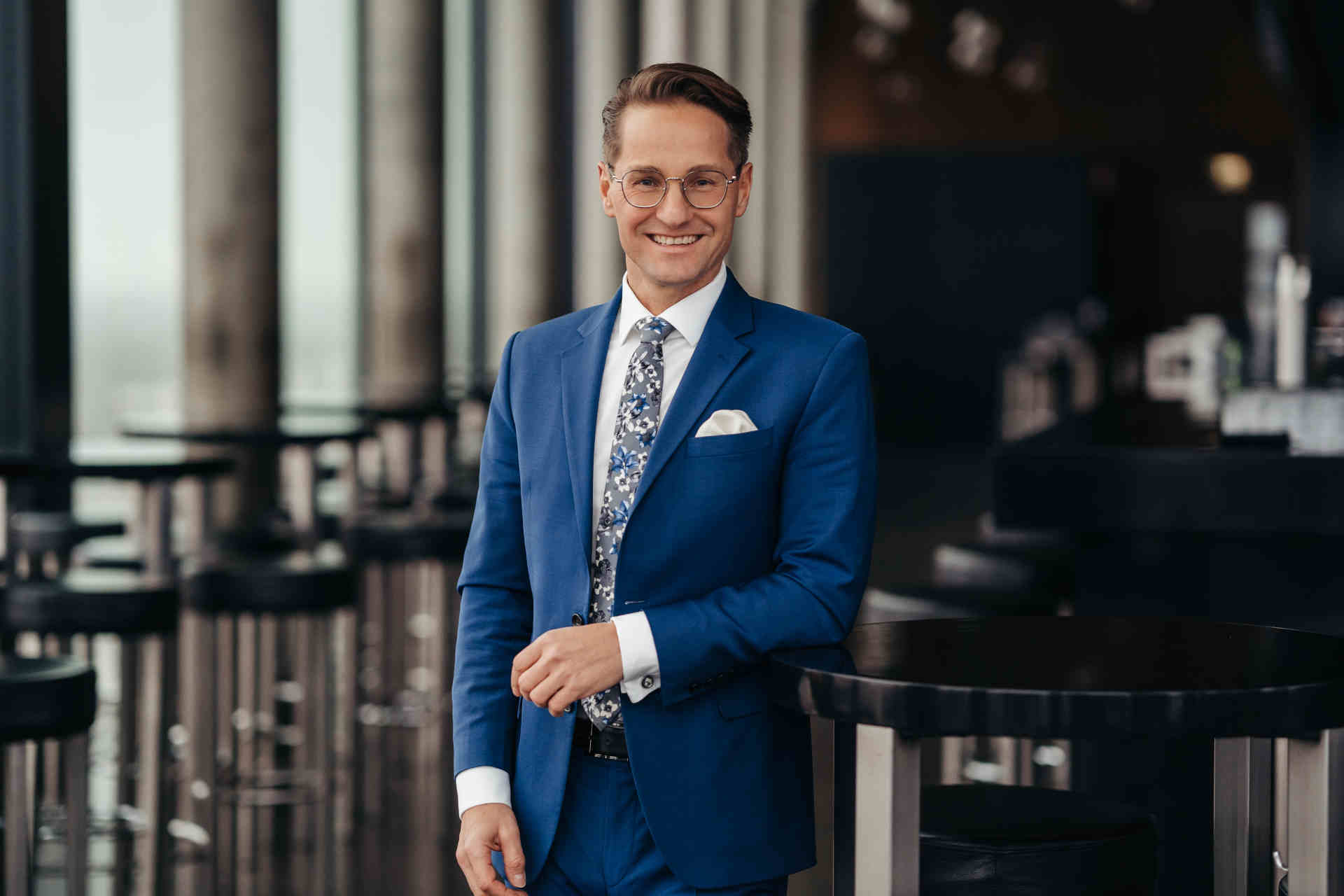
The Hamburg hotel market is growing, qualified staff are in high demand, and a new generation is changing expectations regarding leadership and work. In an interview with GENUSSPUNKT, Enrico Ungermann, General Manager of the Empire Riverside Hotel in Hamburg, talks about the shortage of skilled workers, staff retention and appreciation, his own evolution as a leader, and why the hospitality industry still offers young people exceptional opportunities.
Between skills shortages and a growing hotel market: what the modern hospitality industry must achieve today
Hamburg is one of Germany’s most important hotel and city break destinations; competition for guests – and for good staff – is correspondingly fierce. For hotels, it is therefore no longer enough to focus solely on location, design, rooms and service quality. Behind every successful hotel lies a second layer, often invisible to guests: How are people managed? How do you retain good staff? And what sort of working culture does the hospitality industry need today?
We spoke to Enrico Ungermann, General Manager of the Empire Riverside Hotel in Hamburg, about these issues. The hotel is situated in the heart of St. Pauli, between the Reeperbahn, the River Elbe and the Port of Hamburg, and combines hospitality with a range of dining concepts – from the waterkant restaurant and DAVID’S to the Skyline Bar 20up. Ungermann himself originally comes from the kitchen. And perhaps it is precisely this background that makes his perspective so interesting: he knows the industry not only from management meetings, but from a working environment where long days, rigid hierarchies and a different approach to leadership were the norm for decades. Today, he says: leadership must work differently.
“The challenge is to recruit very good staff”
ALEXANDRA GORSCHE: What are the biggest challenges today for a hotel like the Empire Riverside in a major city and a highly competitive hotel market such as Hamburg?
ENRICO UNGERMANN: One of the biggest challenges is, of course, recruiting excellent staff. And once you’ve managed to attract staff, it’s about retaining them, nurturing them, supporting them and helping them develop. At the same time, the market is growing. More and more hotels are opening, which naturally increases the pressure – for example, on room rates. This makes it all the more important to retain staff. If you look, for example, at our Hotel Hafen Hamburg, which has been in business for decades, you’ll find staff who have spent a very large part of their working lives with us. I think that speaks for itself. But you mustn’t stop developing, and above all, you have to take the teams with you on that journey.
What does this ‘taking them with you’ mean to you specifically?
For me, it means not always approaching issues from a top-down perspective, but working together. You also have to take on board input from the teams and build on it. That’s part of my personal leadership philosophy.
Has your own leadership style changed over the years?
Definitely. If only you knew how I used to lead! (laughs) Naturally, at first you lead in the way you yourself were taught and saw exemplified. I’m a trained chef, and back then it wasn’t always a lot of fun. Today I see things differently. When issues arise, you have to talk to people, raise their awareness and explain to them: Why are we doing this? Why is it necessary? What do we hope to achieve? That’s the only way to inspire, motivate and spur people on.
Restaurant Waterkant
© Empire Riverside Hotel
Empire Riverside Hotel lobby
© Empire Riverside Hotel
Riverview Junior Suite
© Empire Riverside Hotel
From 16-hour days to a new work culture
So the hospitality industry has changed not only from the guests’ perspective, but also as an employer?
Yes, and I think it’s good that this has changed. After finishing hotel management school, I worked my way through various management roles myself and remember very clearly what people used to earn back then and how many hours they worked at the same time. 16-hour days and six- or seven-day weeks over long periods were not uncommon. I’m glad we see things differently today. After all, it’s also about showing appreciation for staff. We certainly don’t want to drive people away from the catering and hospitality sectors. We want to inspire them to love this industry. And you don’t achieve that by – to put it bluntly – bullying them.
Has this shift also changed the way we think about guests today? After all, it used to be said very often: ‘The guest is king.’
Things have changed in that respect too, and I think that’s a good thing. Of course, we’re service providers. But we’re not servants. Just as I treat my staff with respect, I also expect our guests to treat them with respect. If there’s a problem, we can talk about it. You can contact me, a shift manager, a service manager or the restaurant manager. There’s almost always a solution to problems. But if someone feels the need to treat staff at reception or in another area disrespectfully, or to become abusive, then for me there are limits.
Hospitality requires mutual appreciation
Could this perhaps even be one of the positive changes of recent years – that we are talking more about showing appreciation for the people who make hospitality possible in the first place?
Definitely. I think guests are now also becoming more aware of what goes on behind the scenes. We see, for example, restaurants reducing their opening hours or introducing extra days off. And perhaps this also makes us more conscious once again that there is a person working on a Saturday or Sunday, ensuring that I can enjoy a lovely day or evening with my family, with friends or whilst on holiday. This appreciation is important.
If a young person were standing in front of you today, considering a career in the catering or hospitality industry, what would you say to them?
For me, this passion began very early on. I was already in the cooking club at school – I was the only boy there at the time. My mum was a cook, and my aunt also worked in the catering industry. My mum actually tried to talk me out of going into the industry back then. But I was simply fascinated by it. I knew from an early age: I want to work on a ship, I want to go abroad, I want to see something of the world. And that’s exactly what I’d tell young people: if you’re keen to meet lots of people from different countries and with different ways of thinking, and to see the world, this industry opens up an incredible number of opportunities. The hotel and catering industry isn’t confined to a single city or region. You develop professionally, but above all personally. And even if you eventually decide to leave the industry or take a different career path, you take an incredible amount with you. I still find that enriching to this day.
Skyline Bar 20up und Restaurants
© Empire Riverside Hotel
Empire Riverside Hotel
© Empire Riverside Hotel
From chef to general manager: How does a background in the kitchen shape a hotel manager?
You’re a trained chef. To what extent does this culinary background influence your work today as general manager of the Empire Riverside?
It had a particularly strong influence on me at the start, because I naturally come from the F&B sector. You know what levers to pull when it comes to costs, quality and processes. But that doesn’t mean that when I go into the kitchen today, the head chefs start to tremble. Quite the opposite. We have fun together and, of course, know the professional level at which we can talk to one another. And I, too, ask to be shown things. I ask: ‘How are you doing that today?’ That didn’t exist at all in my day. So for me, there’s always something new to learn.
Do you get more involved in the culinary concepts because of your experience?
No. My teams should have the opportunity to develop freely. I don’t go in and scrutinise every menu or dictate what they’re allowed to do and what they’re not. I’ve always demanded that freedom for myself, and that’s why I want to give it to others today as well. Because without freedom, you’ve hardly any chance of developing further. And it’s a very strong motivating factor.
Occupational hazard in the hospitality industry: Can you even stay in a hotel in your private life without immediately analysing everything? What do you look out for yourself?
It depends on how I’m travelling. If I’m travelling on my own and it’s really just about having a place to stay, I’m fairly easy-going. The main thing is that I have a bed. But when I’m travelling for pleasure, I do take a closer look: what does the surrounding area have to offer? What’s the food like? Where can you eat well in the region? For me, the motto these days is more: less, but more intensely. I don’t necessarily need mass tourism. I want peace and quiet and to be able to really enjoy what a place has to offer. For me, it’s about what’s special in that moment.
What the modern hospitality industry can learn from Enrico Ungermann
What is interesting about this conversation is that, ultimately, the major challenges facing the hospitality industry have surprisingly little to do with beds. It’s about people. About staff whom you not only want to recruit, but also to retain. About managers who accept that what used to be considered normal is no longer automatically the right approach today. It’s about the next generation, from whom one must not only demand resilience, but also show them the world this industry can open up. And it’s about guests, whose appreciation does not end with a tip, but begins with treating those people who make hospitality possible with respect. Ungermann’s statement, ‘We are service providers, but not servants’, succinctly sums up this shift. Perhaps this is precisely one of the key tasks of modern hospitality: not less hospitality, but hospitality that remains humane on both sides.
About Enrico Ungermann
Enrico Ungermann is General Manager of the Empire Riverside Hotel in Hamburg and has many years’ experience in the hotel and catering industry. A trained chef, he brings a particularly strong background in food and beverage to his current management role. According to his professional profile, Ungermann has been working as General Manager in Hamburg since 2018. Prior to this, from 2015 to 2018, he served as Deputy Director with responsibility for the food and beverage division. His other professional roles have included positions at the Hotel Hafen Hamburg, the Grand Hotel Heiligendamm, the Upstalsboom Hotelresidenz & Spa in Kühlungsborn and the Carlton Hotel St. Moritz. Today, he describes his leadership style as being characterised above all by dialogue, personal responsibility, opportunities for development and mutual respect. His career path from the kitchen to hotel management continues to shape his perspective on the hospitality industry, operational processes and collaboration with his teams.
Position: General Manager, Empire Riverside Hotel & Hotel Hafen Hamburg
Location: Hamburg, Germany
Background: trained chef, hospitality & food & beverage
Other positions held: Grand Hotel Heiligendamm, Upstalsboom Hotelresidenz & Spa Kühlungsborn, Carlton Hotel St. Moritz