An interview with Guillaume Galliot: “Generosity is one rule I would never break”
22 years in Asia, French cuisine as his foundation and vinegar as his secret weapon for sauces
08 October 2026 · Alexandra Gorsche
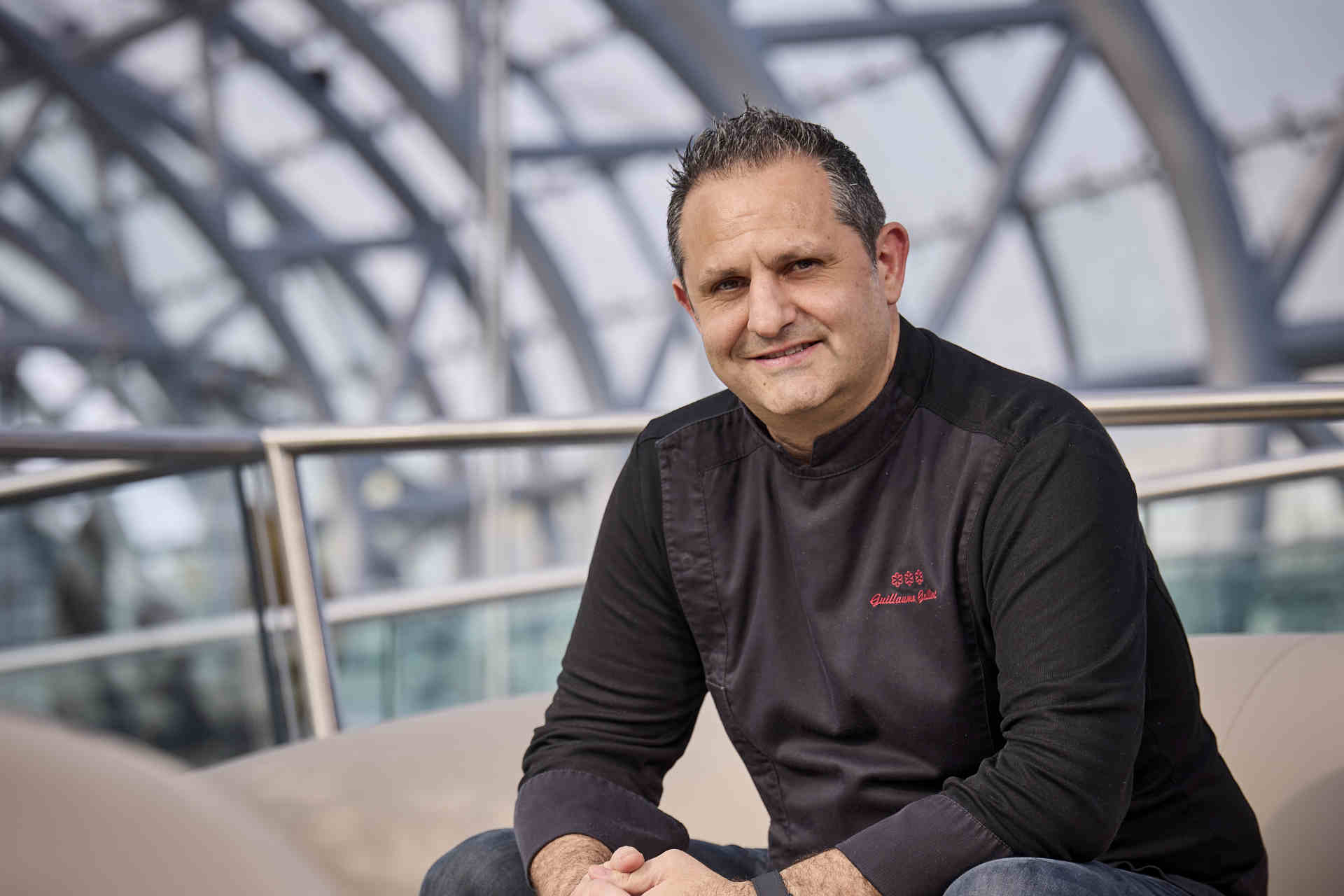
Guillaume Galliot has had a remarkable career. France. Saint-Barthélemy. New York. Singapore. Beijing. Macau. Hong Kong. At the age of 23, he became the youngest sous-chef in the history of the Raffles Hotel in Singapore; he later earned two Michelin stars in Macau. Since 2017, he has been at the helm of Caprice at the Four Seasons Hotel Hong Kong; the restaurant has held three Michelin stars consistently since 2019. Despite all these stops along the way, Galliot has never traded his culinary identity for a new one. His cuisine remains French. In this ‘Genusspunkt’ interview, he explains why Asia, of all places, has given him greater freedom in this regard, why he often prefers wine to vinegar in sauces, and why generosity is a fundamental culinary principle for him.
ALEXANDRA GORSCHE: You’ve cooked in New York, Singapore, Beijing, Macau and Hong Kong. Why has your cuisine remained French despite that?
GUILLAUME GALLIOT: Because that’s my foundation. I’ve now spent 22 years in Asia. So, actually, more years in Asia than in Europe. When I put it like that, it sounds almost a bit daunting. (laughs) But for me, it’s above all a great privilege. I can play with two different terroirs: the European and the Asian. When these two worlds come together, it’s almost a luxury problem for a chef.
Is it precisely this long period in Asia that makes you feel freer today?
Absolutely. Asian culture has given me so much. I feel extremely at home there, and it has also made me more open-minded in my work and in my kitchen. Perhaps I’d even be less open-minded today if I’d stayed exclusively in France.
What’s so special about Hong Kong from a chef’s perspective?
Above all, the ingredients. In Hong Kong, you have access to produce from practically all over Asia. Japanese produce, herbs from Vietnam, vegetables and fish from China – so much is readily available. And at the same time, an incredible number of different cultures come together there. You can find outstanding French, Italian, Cantonese, Vietnamese and Thai cuisine. Hong Kong really is a melting pot.
“Asian culture has had a huge influence on me and given me so much.”
Is there an Asian food that particularly fascinates you?
Citrus fruits. There’s an incredible amount to discover there. Malaysia, Indonesia, Japan, China, the Philippines – every country has different varieties and different flavours. For a chef, this diversity is wonderful.
If you were in your early 20s again, would you change anything about the path you’ve taken?
That’s an interesting question. (Short pause) No. Perhaps I could have worked in France a little longer. But the question is: what would that actually have achieved for me? Asian culture has had a profound influence on me and given me so much. My four years in China were fantastic. Macau, Singapore, New York, the Caribbean – and I even spent about four months in Morocco to learn more about spices. Every single stage of my career has been important to my culinary journey. I don’t regret a single decision.
Sauce is one of the most important elements of French cuisine. What makes a really good sauce?
For me, the key factors are complexity, body and the length on the palate. That’s what makes the difference in the end. And for me personally, vinegar is a key ingredient.
Do you prefer to work with vinegar rather than wine?
Very often, yes. I like to use vinegar in my sauces. It gives me the balance I’m looking for. I use wine relatively rarely, however, because I find it less stable. Depending on the grape variety and character, wines can vary greatly and sometimes add a certain heaviness to a sauce. Of course, there are exceptions. Vin Jaune, for example, can work very well with cheese. But generally speaking, I often opt for vinegar.
When do you use it?
It can be as early as during the reduction stage. Or right at the very end, when seasoning to taste. For me, vinegar is a wonderful ingredient for bringing balance to a sauce. It’s definitely one of my favourite ingredients.
Which is more important: technique or intuition?
You need both. If you rely solely on intuition but lack technique, it won’t work. You need a strong technical foundation so that you can truly express your intuition in the first place. Without good technique, you cannot fully convey what you feel onto the plate. Otherwise, the dish won’t come together and won’t be truly satisfying.
Red mullet – seafood consommé – Timut pepper – coriander
© Helge Kirchberger Photography
Alexandra Gorsche and Guillaume Galliot
© Genusspunkt
Mille-feuille – banana – chocolate – cocoa sorbet
© Helge Kirchberger Photography
Is there a rule in French cuisine that you would never break?
Generosity. You have to maintain that in your cooking. The moment you lose that generosity and start to become too sparing, something essential is missing for me. That is one of the most important rules of all.
What does ‘generosity’ mean on the plate?
Generosity itself, of course. But I also want guests to sense my story and the experiences from my travels. Morocco. Hong Kong. China. Singapore. All these experiences are reflected in my cuisine. I hope that guests can feel this story on the plate.
You’re not just a chef, but also a manager. What makes a good leader?
Being attentive. Staying close to your staff. Listening – to guests as well as to your own team. And, if possible, creating a family atmosphere. At the end of the day, we’re simply chefs. If you’re close to your staff and your guests, you understand better what people are feeling. And once you understand those feelings, it becomes much easier to live out your passion.
You speak of passion. Does your work still feel like work?
Not really. I always say: ‘I don’t go to work. I live my passion.’ I don’t go to work. I go there to have fun with my team.
Perhaps the most important sentence of the conversation
It would be easy to recount Guillaume Galliot’s career in terms of Michelin stars, the restaurants he has worked at and his international experience. But perhaps this one word says more about him: generosity.
For his career is international. His cuisine is French. His range of ingredients is global. And his aim is surprisingly fundamental: a guest should not merely recognise technical skill. They should gain something. Flavour. Product. Emotion. Generosity.
For us, this is precisely what makes his cuisine so special: it does not seek to appear more intellectually sophisticated than it is. It aims to taste more generous than one might expect.
Fact box: Guillaume Galliot
Born: 1981 in Chambray-lès-Tours in the Loire Valley, France.
Culinary background: Jardin des Sens under Jacques and Laurent Pourcel in Montpellier; the restaurant held three Michelin stars at the time.
Pastry experience: At Jardin des Sens, Galliot also worked in the pastry kitchen, where, according to a press release, he developed a keen understanding of precision and menu composition.
International posts: Saint-Barthélemy, New York, Singapore, Beijing, Macau and Hong Kong.
Raffles Hotel Singapore: At the age of 23, he became the youngest sous-chef in the hotel’s history, according to a press release.
Macau: At The Tasting Room by Galliot, he earned two Michelin stars.
Hong Kong: Galliot has been running Caprice at the Four Seasons Hotel Hong Kong since 2017. Since 2019, the restaurant has once again held three Michelin stars without interruption.
Asia’s 50 Best Restaurants 2026: Caprice is ranked 35th.
Culinary style: French technique and a fundamental understanding of French cuisine, enriched by flavours, ingredients and experiences gained over more than two decades in Asia.
Favourite ingredient for sauces: vinegar, particularly for balance and acidity.
Non-negotiable rule: generosity.
Leadership principle: be attentive, listen and stay close to the team and guests.