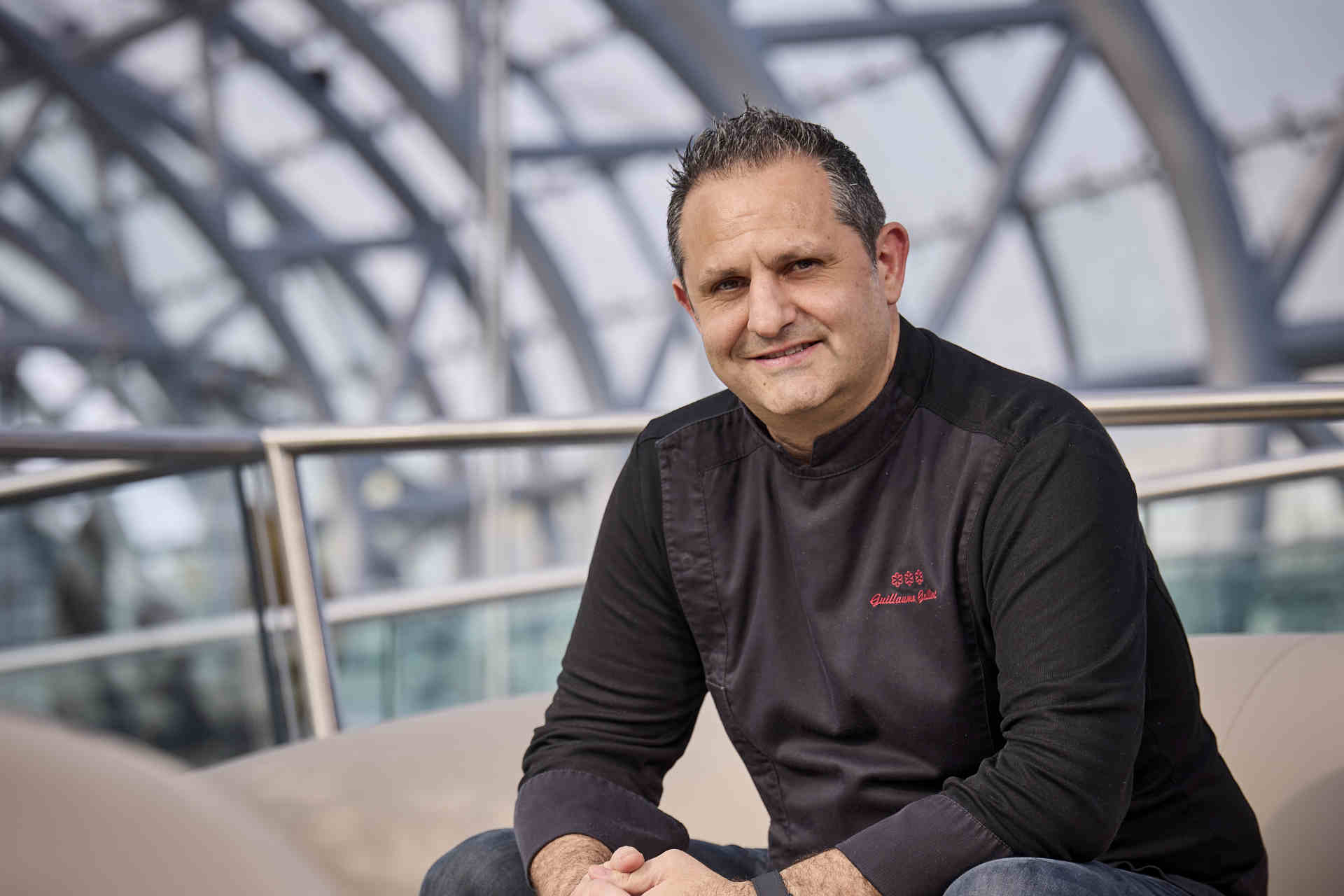
Guillaume Galliot at the Ikarus
A menu blending French soul with Asian depth
04 October 2026 · Alexandra Gorsche
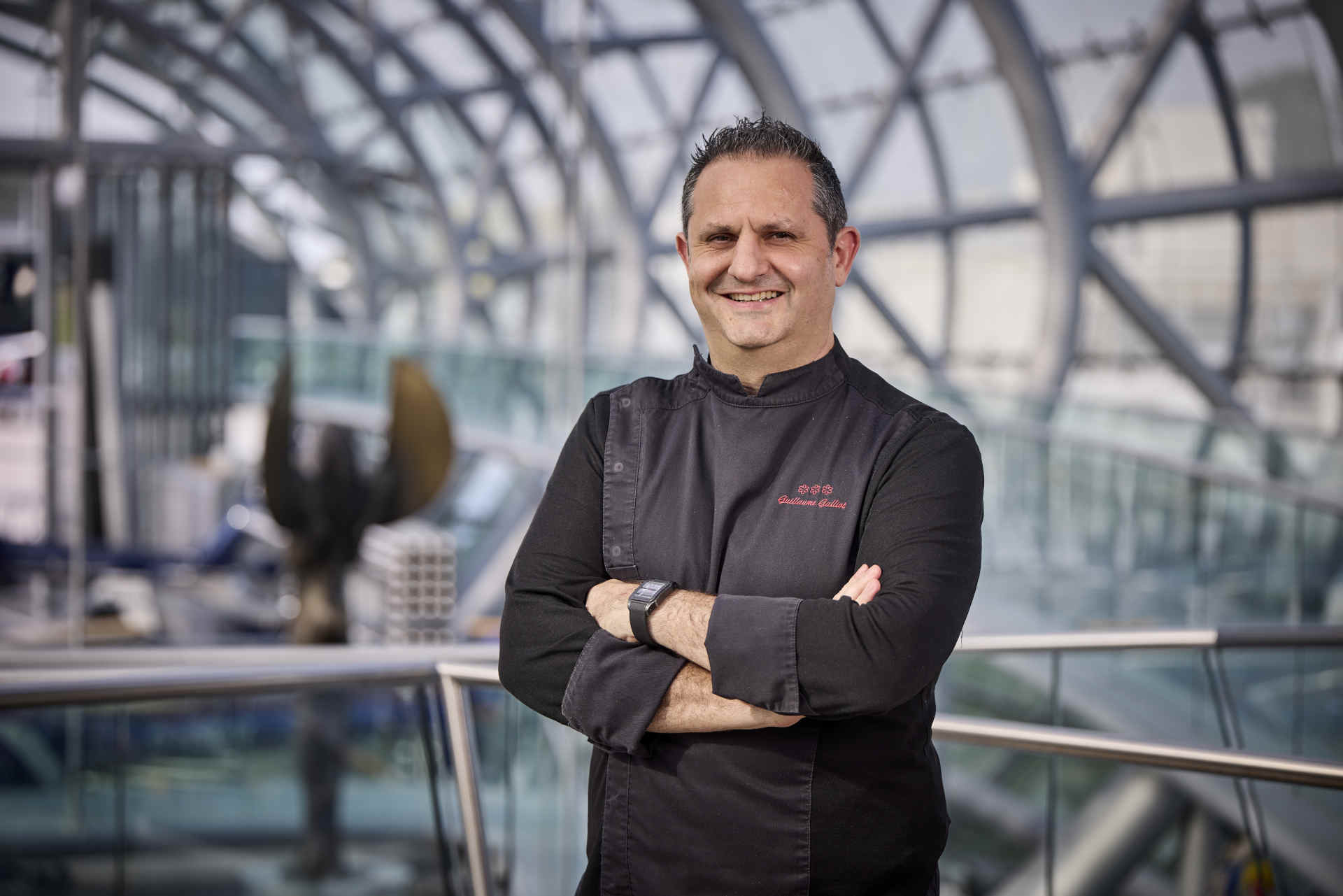
Three Michelin stars, more than two decades in Asia, and yet uncompromisingly French: at the Ikarus restaurant in Hangar-7, Guillaume Galliot presents a menu that speaks less of fusion than of attitude, precision and exceptionally fine ingredients.
A cuisine that is French at its core
At Guillaume Galliot’s restaurant, lobster meets calamansi, red mullet meets Timut pepper, wild hare meets quince and Roquefort, and Breton lobster meets beetroot and chocolate. It would be easy to turn this into a story about fusion cuisine. But that would be wrong. For Galliot himself insists that his cuisine has remained French at its core. French technique, the French understanding of sauce, French food culture. What his years in Asia have changed is not his culinary identity, but its depth. His experiences have not rewritten his cuisine, but enriched it. In October 2026, Galliot will be the guest chef at Restaurant Ikarus in Hangar-7, bringing with him an exceptionally generous menu.
Lamb from Maison Greffeuille: saddle and shoulder – kohlrabi – peas – mint
© Helge Kirchberger Photography
Breton lobster – beetroot – chocolate – Ruby sauce
© Helge Kirchberger Photography
A French foundation that has travelled the world
Guillaume Galliot was born in 1981 in Chambray-lès-Tours in the Loire Valley. However, he did not lay his first culinary foundations in a professional kitchen, but in his grandmother’s garden. She cooked with whatever the season had to offer and treated good food with a matter-of-factness that today seems almost like a deliberate counterpoint to over-the-top presentation. Later, Galliot worked at the Jardin des Sens in Montpellier under Jacques and Laurent Pourcel. At the time, the restaurant held three Michelin stars and was renowned for its Mediterranean-inspired French cuisine. Of particular interest: Galliot also worked in the patisserie there. This period not only honed his precision but also his understanding of how individual courses within a tasting menu must work together.
After that, his culinary horizons broadened. At the age of 21, he moved to Saint-Barthélemy, and later to New York. In Singapore, at the age of 23, he became the youngest sous-chef in the history of the Raffles Hotel. This was followed by four years in Beijing, then Macau, and finally Hong Kong. Beijing was a significant stop on his journey, as the foundations of Chinese cuisine were of immense importance to him. In 2017, he finally took over Caprice at the Four Seasons Hotel Hong Kong. Since 2019, the restaurant has once again held three Michelin stars without interruption; in 2026, Caprice ranked 35th on the Asia’s 50 Best Restaurants list. And quite rightly so, in our view. In conversation, Galliot himself sums up his extraordinary position with an interesting phrase: “I’m lucky to play with two different terroirs, European terroir and Asian terroir.” Twenty-two years in Asia – more time than he has now spent in Europe. And yet his cuisine still finds its roots in France.
A menu that doesn’t set out to be fusion
This is evident right from the start. Lobster tartlet with dill and calamansi, foie gras with black garlic and hazelnut, anchovy roll with Roscoff onion and olive. Even these very first bites bear the hallmarks of Galliot’s style. Luxurious ingredients meet elements that create a sense of excitement: calamansi brings precise citrus notes, black garlic adds fermented sweetness and depth, whilst anchovies and olives contribute saltiness and umami. The flavours have an international feel, yet the underlying structure remains French. Galliot’s cuisine becomes even more evident with the king crab: shellfish jelly, Gillardeau oyster, fennel and Oscietra caviar. This is anything but understated. And therein lies a central tenet of his philosophy: generosity. When asked which rule of French cuisine he would never break, Galliot replies without hesitation with this single word. Generosity. Not in the sense of over-the-top portions, but as an attitude towards ingredients, flavour and the guest. King crab, Gillardeau oysters and Oscietra caviar are therefore not merely a luxurious display, but an expression of this understanding.
The menu then takes on a darker, more intense character: wild hare soup with quince purée, Roquefort, biscotti and foie gras. It is precisely here that something becomes apparent which Galliot repeatedly emphasises in conversation: for him, balance is not achieved through restraint, but through contrasting elements. Game, liver and blue cheese bring depth and strength; the quince, by contrast, adds fruitiness and acidity. For him, this balance is crucial, particularly when it comes to sauces. And this is where things get particularly fascinating from a technical perspective. Galliot says he works very frequently with vinegar and considerably less often with wine. He finds wine more variable and believes it can lend a sauce additional heaviness. Vinegar, on the other hand, allows him to precisely control acidity and balance, both in a reduction and right at the very end when seasoning to taste. He describes what makes a good sauce using three terms: complexity, body and length on the palate. An interesting insight into his cuisine: for him, acidity should not dominate. Instead, it should ensure that everything else tastes more precise. To this end, we’ll be tasting two accompaniments by the glass: the standard version and the ‘upgrade’: The 20-Year-Old Tawny from Quinta de la Rosa pairs elegantly with hare, foie gras and Roquefort thanks to its nutty notes, oxidative maturity and freshness; the ‘upgrade’ with the 1955 Don PX ‘Convento Selección’ takes things significantly further: denser, darker, sweeter and almost like an additional course in its own right.
His Asian influence is once again particularly evident in the red mullet served with a seafood consommé, Timut pepper and coriander. In conversation, Galliot raves especially about the variety of Asian citrus fruits and about Hong Kong as a culinary melting pot. Japanese produce, Vietnamese herbs, Chinese vegetables and fish – for him, the city is extraordinary above all because so many different food worlds and culinary cultures are available there at the same time. But here too, the same principle applies: he does not simply adopt these cuisines. He integrates their flavours into his own system. The Breton lobster with beetroot, chocolate and ruby sauce illustrates this particularly clearly. Chocolate with lobster sounds almost provocative at first. But Galliot’s cuisine is not about provocation. Sweetness, earthiness, bitterness, acidity and the natural sweetness of the crustacean are balanced against one another. Fittingly, he says in an interview: ‘You need a strong technical foundation to be able to express your feelings.’ Feeling alone is not enough for him. For Galliot, technique is not an end in itself, but the prerequisite for being able to cook freely. The 2010 Pommard Premier Cru ‘Les Bertins’ from Domaine Chantal Lescure is a particularly harmonious accompaniment: its mature Burgundian depth, subtle earthiness and precise acidity complement the beetroot and the dark chocolate notes without overpowering the sweetness of the lobster.
Red mullet – seafood consommé – Timut pepper – coriander
© Helge Kirchberger Photography
Mille-feuille – banana – chocolate – cocoa sorbet
© Helge Kirchberger Photography
Product over showmanship
By comparison, the main course seems almost classic: lamb from Maison Greffeuille – loin and shoulder – served with kohlrabi, peas and mint. Galliot doesn’t feel the need to transform every ingredient. With him, exceptional ingredients are simply allowed to be what they are: exceptionally good. This focus on ingredients takes us back to his earliest culinary foundations: his grandmother’s garden, seasonal cooking and a respectful approach to food. The circle is complete. Before the final dessert comes lemon with yoghurt and vanilla. After game, lobster and lamb, this feels almost like an aromatic reset: clean, fresh, with a pronounced acidity. And then the menu returns quite naturally to France once more: mille-feuille with banana, chocolate and cocoa sorbet. The fact that Galliot also worked in the patisserie at the Jardin des Sens, where he developed his flair for precision and menu composition, takes on an almost added significance here. The dessert feels like a little reminder of where his culinary language began.
A cuisine that has travelled far and wide, yet still knows where it belongs
After more than two decades in Asia, Guillaume Galliot could easily define his cuisine in terms of its international character. He does not. His foundation remains French. What has changed is the breadth of his approach. More ingredients. More acidity. More spices. More terroirs. More culinary cultures. And perhaps that is precisely his strength: he no longer needs to prove how international he is. Galliot himself would probably choose a different word: generosity. And after this menu, you understand quite exactly what he means by that.