When the Hosts Tell Their Own Story
Martin Klein and the Ikarus Team in August 2026
10 August 2026 · Alexandra Gorsche
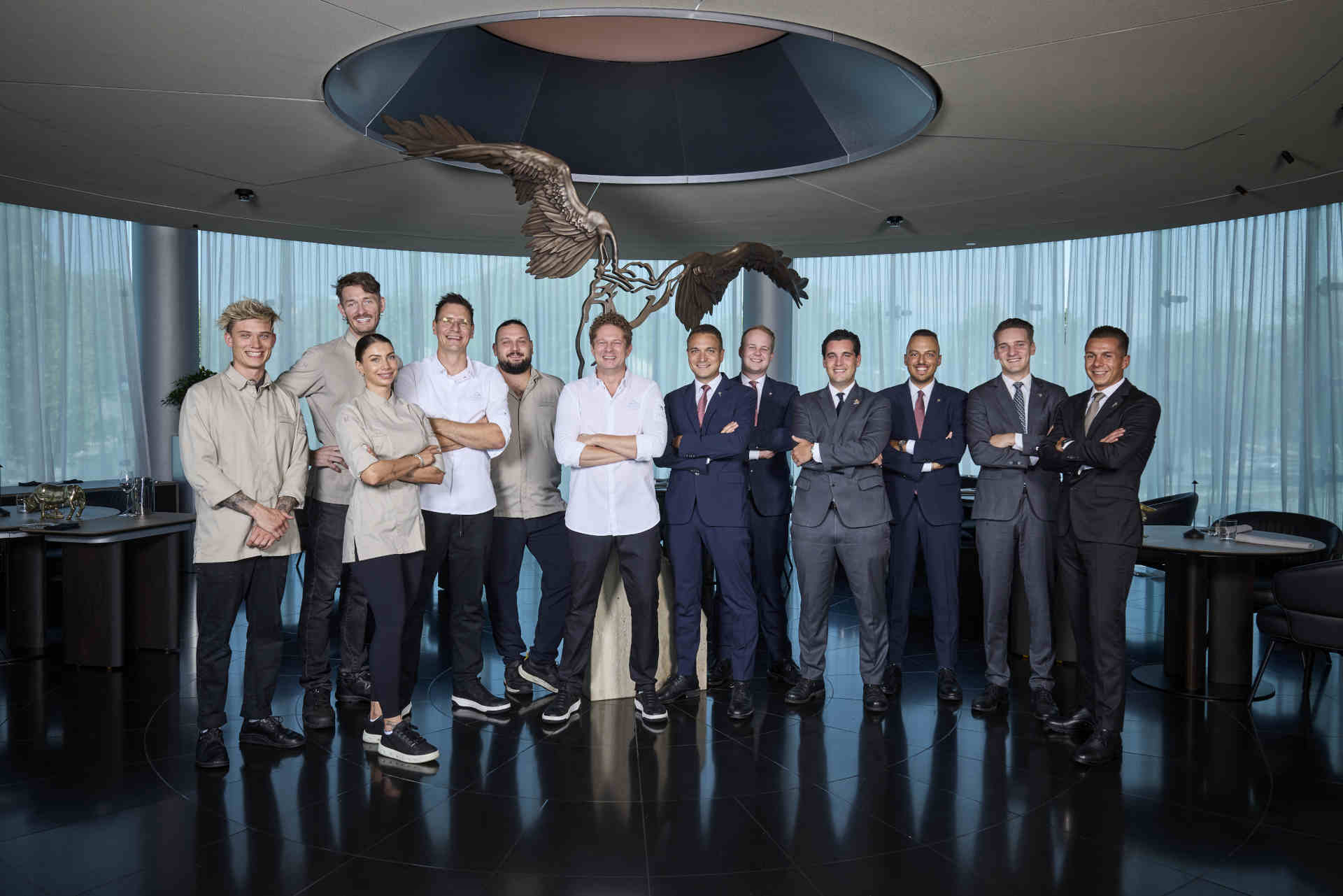
At the Salzburg restaurant Ikarus in Hangar-7, the culinary signatures change every month. But once a year, the stage belongs to those who master all these languages: Martin Klein and his team. The August 2026 menu is a multi-layered, surprisingly light essence of more than two decades of top-tier international cuisine. Accompanied by wines that leave even connoisseurs in awe.
There are restaurants that cultivate an unmistakable signature style.
And then there is Ikarus: a restaurant defined precisely by its ability to understand, internalize, and rewrite a different signature style every single month with remarkable precision. For more than two decades, Hangar-7 has invited top international chefs to Salzburg. Their menus are not merely copied or quoted. Martin Klein and his team travel to meet the guest chefs, immerse themselves in their culinary worlds, study techniques, ingredients, and workflows, and then translate them into the kitchen of Restaurant Ikarus. It is a concept whose consistency is unique worldwide. Each month, a completely new menu is created, driven by the philosophy of a different guest chef. But what happens when the hosts tell their own story?
August is not just any month at Restaurant Ikarus
During the Salzburg Festival month, the house’s usual dramaturgy is traditionally reversed. Instead of spotlighting an international guest chef, August is when Executive Chef Martin Klein and the Ikarus team present their own culinary identity. Here, their “own signature” represents the distilled essence of countless encounters: French sauce culture, Japanese precision, Asian aromatics, Nordic clarity, Mediterranean lightness, and, throughout it all, the curiosity without which this concept could never have thrived for so many years. More than 270 guest chefs have cooked at Restaurant Ikarus to date. The team has had to learn just as many culinary languages, decode techniques, and understand kitchen philosophies. August is therefore not a mere showcase of prowess. It is a snapshot of an ongoing learning process – and proof that a strong identity is sometimes born from openness. Restaurant Ikarus is awarded two Michelin stars in the Guide Michelin Austria 2026. The inspectors describe it as an address with excellent cuisine set within the spectacular architecture of Hangar-7. Yet this evening quickly makes one thing clear: the venue’s true greatness lies not only in its technical perfection. It lies in its versatility.
An opening that immediately sets the tone
The menu begins with a series of precisely placed exclamation points. A tomato cornetto opens the evening on a playful note. Right after, the pairing of black truffle, fig, and kohlrabi reveals what the coming hours will be all about: luxury that is not defined by heaviness. The earthy depth of the truffle meets fruit and the crisp, juicy freshness of kohlrabi. Next, the lake trout is paired with alpine rose, yam root, and umeboshi. Here, alpine associations meet Japanese fermentation. The umeboshi brings that concentrated acidity and salinity that gives contour to what might otherwise seem a gentle dish. The combination feels organic rather than contrived, as if the lake trout had simply been waiting for these flavors. With the squid with Buddha’s hand and caviar, the interplay becomes even sharper. The fragrant, almost floral citrus aroma of the Buddha’s hand strips away any ostentatious opulence from the caviar. Instead, it yields a course that feels maritime, precise, and bright. The cockle with samphire, Asian pear, and oxalis follows the same principle. Salty ocean notes meet the juicy chill of the pear and the delicate acidity of wood sorrel. It is a dish that reads almost like a miniature landscape: coast, vegetation, fruit, water. These initial sequences in particular highlight a core strength of the menu: acidity is not used for mere effect, but as an organizing force. It structures, extends flavors, and keeps even complex combinations vibrant and dynamic.
One showstopper after another
With foie gras, cherry blossom, and pistachio comes an ingredient that can easily become an overwhelming focal point in a menu. Yet here, too, the kitchen avoids overt heaviness. The floral cherry blossom and nutty pistachio take nothing away from the richness of the duck liver, but provide it with a lighter frame. To accompany it, two wines are served simultaneously: a 2013 Riesling “M” Reserve from Weingut F. X. Pichler from the Wachau and a 2021 Beaujolais from Domaine Jules Desjourneys.
This dual pairing is more than generous hospitality. It opens up two distinct readings of the same dish. The mature Riesling plays with tension, age, and acidity, while the modern pairing, the Beaujolais, highlights the fruity and floral components. Wine here is conceived as a change of perspective. Had we been forced to choose, our preference would have gone to the more exciting red route, as the Beaujolais, with its fruit and subtle spice, echoed the cherry blossom with particular elegance.
Foie Gras – Cherry Blossom – Pistachio
© Helge Kirchberger Photography
Thai Wagyu Beef – Peanut – Cucumber – Curry
© Helge Kirchberger Photography
King crab, koji, and vanilla: a balancing act
One of the evening’s most memorable courses is the king crab with rice koji, beurre blanc, and vanilla. The list of ingredients alone sounds daring. The natural sweetness of the king crab, the rich creaminess of a beurre blanc, and the warm aromatics of vanilla could easily tip into cloying richness. But that is precisely what does not happen. The rice koji contributes fermentative depth, umami, and subtle spice. The vanilla does not signal dessert, but acts as an aromatic amplifier for the crab. Everything is present, nothing is loud. The course is creamy and complex. In the standard wine pairing, this is accompanied by the 2022 Montes Obarenes from Bodegas Gómez Cruzado in Rioja – a white wine whose exclusivity extends beyond what is in the glass. White wine accounts for only about ten percent of wine production in Rioja, and of that, only around five percent is exported. All the more remarkable that even the “classic” wine pairing at Ikarus features such a rare selection. As an upgrade, a 2016 Hermitage Blanc from Domaine Jean-Louis Chave is available. Priced at 129 euros per glass, it underscores the caliber of not just the cooking, but the curation as well.
Thai Wagyu: power meets freshness
The Thai Wagyu beef with peanut, cucumber, and curry is an anticipated powerhouse course of the menu. The highly marbled meat brings richness and depth, while cucumber and curry counter with freshness, spice, and aromatic agility. The peanut does not appear as a heavy, sweet sauce, but as a binding, nutty element. Especially with an ingredient like Wagyu, there is always the risk of fat becoming the sole focus of the experience. Here, it serves instead as a flavor carrier for a precise interplay of heat, freshness, acidity, and spice. It is paired with the 2024 Trepat “Puños Fuera” by Òrbita Venus from Montsant. As we were told at the restaurant, this wine is available in Austria exclusively at Hangar-7. That alone does not make it significant – exclusivity in itself is not quality. It becomes exciting when a wine is woven so seamlessly into the dramaturgy of a dish: the red fruit and vibrant structure of the Trepat complement the meat without weighing down its marbling.
Scallop between peach and Vin Jaune
The scallop with peach, Sichuan pepper, Vin Jaune, and marigold oil is perhaps one of the aromatically boldest courses on the menu. The sweetness of the scallop and peach is cut by the vibrant, gently numbing spice of the Sichuan pepper. The Vin Jaune brings nutty, oxidative depth, while the marigold oil lifts everything with its citrus and herbal notes. What sounds on paper like a competition for attention becomes a remarkably precise dialogue on the plate. No single flavor is meant to dominate. Instead, the tension arises precisely from how all the components keep each other in check. It is served with a 2021 Meursault “Les Tillets” from Domaine Vincent Girardin. As an upgrade, the 2022 vintage from Domaine Bernard-Bonin is available at 95 euros per glass.
Scallop – Peach – Sichuan Pepper – Vin Jaune – Marigold Oil
© Helge Kirchberger Photography
Apple – Chamomile – Ginger
© Helge Kirchberger Photography
Venison and the scent of the forest
With the Polting venison with cabbage, juniper, and fir, the aromatics turn darker. After the maritime, fruity, and Asian-influenced sequences, the menu steps into the forest. Juniper and fir could easily turn into an overly obvious staging of game. Yet this course, too, remains remarkably clear. The cabbage brings earthiness and structure without dragging the venison into rustic heaviness. The dish is paired with a 2004 Magari by Ca’ Marcanda from Tuscany. Guests who choose the upgrade receive a 2002 Château Haut-Brion 1er Cru Classé from magnum, listed at 142 euros per glass. It is here that the expertise of the service and sommelier team shines brightest. Grand labels are not presented like trophies; they are explained, contextualized, and placed within a culinary narrative. This reflects the atmosphere of the entire establishment: consummate professionalism, free of stiff reverence.
From apple to “Coconut Coffee”
Before the dessert proper begins, apple with chamomile and ginger acts like a culinary deep breath. Acidity, floral notes, and a gentle kick of spice bring the palate back into sharp focus. It is served alongside the 2023 Givre de Glace from the Dupont family in Normandy. The finale is named “Coconut Coffee”: espresso parfait, young coconut, and passion fruit. Here again, the menu remains true to itself. Coffee brings bitterness, coconut offers creaminess, and passion fruit delivers its unmistakable acidity. It is a dessert with a tropical feel, but without the heavy tropical sweetness. It is paired with the 2021 Noble One from De Bortoli Wines in New South Wales. According to the team, this Australian dessert wine is currently offered in this format exclusively at Restaurant Ikarus across Europe. It is a remarkable detail, particularly because the wine is not used as a showy grand finale, but as a precise partner to espresso, coconut, and passion fruit.
The Rare Wine Pairing: when wine becomes a second menu
Alongside the standard wine pairing for 225 euros, Ikarus offers a Rare Wine Pairing for 777 euros. This is far more than just a collection of prestigious names.
The lineup includes:
Château Pape Clément Blanc 2016, Bordeaux
Morey-Saint-Denis 1er Cru “Les Millandes” Vieilles Vignes 2023, Guilbert Gillet
Hermitage Blanc 2016, Domaine Jean-Louis Chave
Barolo “Francia” 2016, Giacomo Conterno
Meursault “Les Tillets” 2022, Domaine Bernard-Bonin
Château Haut-Brion 1er Cru Classé 2002 from magnum
Scheurebe Trockenbeerenauslese “Nr. 12” Zwischen den Seen 1998, Weinlaubenhof Kracher
Château d’Yquem Premier Cru Classé Supérieur 2022 from magnum
It reads like oenological nobility – and it undoubtedly is. But the real distinction lies in the opportunity to experience these wines not in isolation at a tasting, but within a meticulously calibrated menu progression. A great wine already tells a rich story on its own. In harmony with a dish, however, its vocabulary transforms. Suddenly, different aromas come to the fore, structures shift, and maturity is perceived in a whole new light. The rare wine pairing thus becomes a second, parallel tasting menu. The breadth is particularly impressive: from white Bordeaux to Hermitage and Meursault, through to Barolo, Haut-Brion, Kracher, and Château d’Yquem. It is not merely about market value or rarity. It is about style, maturity, provenance, and how wine can do more than accompany a dish – it can comment on it.
Haute cuisine with nothing to prove
What remains after this evening? First and foremost, the realization that despite its abundance, this menu feels remarkably light on its feet. It works with foie gras, beurre blanc, Wagyu, venison, and grand wines, yet never feels heavy. The reason lies in the rigor with which fruit, vegetables, herbs, and acidity are deployed. Kohlrabi, yam root, cucumber, Asian pear, peach, apple, passion fruit, umeboshi, and oxalis ensure that after many courses, it is curiosity, not fullness, that prevails. This lightness is the result of technical precision, experience, and restraint. After all, great cuisine is not measured by how much a chef can pile onto a plate, but by what is left off, when a flavor is pulled back, and how long an idea resonates. At Ikarus, Martin Klein and his team must convincingly interpret a different culinary style every month. In August, they show what this decades-long openness has made of them. The result is not a best-of compilation of past guest-chef menus. Nor is it a culinary world tour in the conventional sense. It is an independent language forged from many languages. Perhaps that is the true signature of Ikarus: not stylistic rigidity, but the ability to continuously evolve without ever losing itself.
Info Box: Martin Klein
Position: Executive Chef, Red Bull Hangar-7
Restaurant: Ikarus in Hangar-7, Salzburg
Accolade: Two Michelin stars in the Guide Michelin Austria 2026
Concept: Monthly changing menus by top international chefs
Special feature in August: Original menu by Martin Klein and the Ikarus team
Martin Klein knows the guest chef concept like almost no one else. From 2003 to 2012, he served as Chef de Cuisine at Restaurant Ikarus. Following a tenure on Laucala Island in the South Pacific, he returned to Hangar-7 in 2014 as Executive Chef. Since then, he has traveled to meet top international chefs, learning their kitchens firsthand and collaborating with them to develop the monthly menus for Salzburg. His role, however, goes far beyond cooking: Klein is scout, translator, host, and curator all at once. Together with Head Chef Martin Ebert, Executive Pastry Chef Stefan Howells, the sous chefs, and the entire brigade, he ensures that an outside culinary idea becomes an authentic Ikarus experience for a full month.
Menu and Prices in August 2026
Full menu: 285 euros
Shortened menu: 245 euros
Without cockle, king crab, and apple
Wine pairing: 225 euros
Rare wine pairing: 777 euros
Restaurant Ikarus is located in Red Bull Hangar-7 in Salzburg. It is currently open Monday through Thursday for dinner, and Friday and Saturday for lunch and dinner; it is closed on Sundays and public holidays. As opening hours and availability may vary, early reservations and direct confirmation with the restaurant are recommended.